04.06.2026
#58
Simon Rost
GE Healthcare
Leading at scale in the medical imaging business
Listen on your favorite platform:


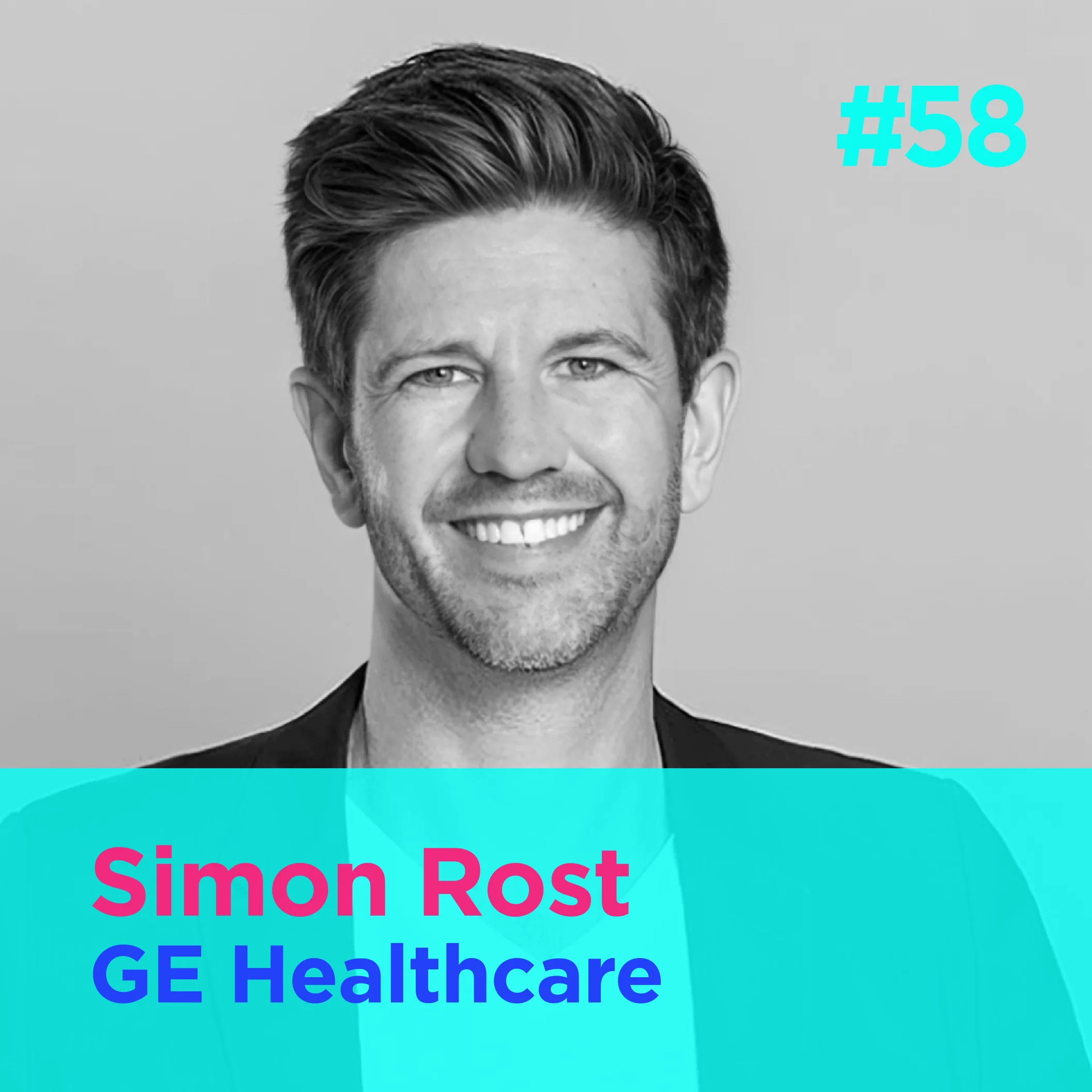
Simon is the CMO of Enterprise Digital Solutions at GE HealthCare, building AI software that helps doctors read medical scans faster, shifting the focus from manual data sorting to precise patient care.
Episode notes
One third of all data generated globally comes from the healthcare sector, yet a staggering 97% of it remains unused, trapped in siloed systems. This "big crime" of wasted potential is exactly what Simon Rost and his team at GE Healthcare are determined to solve.
As the Global Marketing Officer for Enterprise Imaging, Simon sits at the helm of a business that touches over a billion patients a year.
In a world where medical imaging is the bedrock of diagnosis, the challenge isn't just about capturing the image anymore—it’s about what we do with the intelligence hidden within it.
In this episode of Impulse, Simon breaks down the transition from "Big Iron" hardware to the invisible power of enterprise medical imaging software. We dive into the rise of Agentic AI—AI that doesn’t just analyze but takes action—and how GE Healthcare is moving toward a future of autonomous imaging to free up clinicians for what matters most: the patient.
We also explore the critical shift in commercial models from CapEx (capital expenditure) to SaaS (software-as-a-service), the necessity of an open ecosystem over "walled gardens," and why interoperability must be the innovation of the decade.
Simon even shares a personal anecdote about how GE’s technology bookended the birth of his son, bringing the scale of MedTech down to the most human level.
Whether you are a radiologist, a healthtech entrepreneur, or a data enthusiast, this conversation is a masterclass in how a global giant is retooling for the AI-first era of medicine!
Timeline:
- 00:00:00 - Simon’s journey in MedTech and enterprise imaging software at GE Healthcare
- 00:05:50 - The trends of AI in healthcare from Simon’s perspective
- 00:12:04 - Where AI and hardware meet in medical devices
- 00:14:35 - Positioning GE Healthcare’s portfolio along the end-to-end patient journey
- 00:20:27 - How GE Healthcare builds the value proposition and commercial models of its enterprise imaging software
- 00:28:15 - GE Healthcare’s philosophy regarding partnerships and building ecosystems
- 00:33:37 - Simon’s predictions for the future of medical imaging
What we also talked about with Simon:
We mentioned with Simon some of the past episodes of the series:
- #16 - Making ultrasound portable to transform medical imaging - Ohad Arazi - Clarius
- #32 - Accelerating radiology with AI - Amine Korchi - Radiologist
- #36 - Turning healthcare preventive with full-body MRI scans - Andrew Lacy - Prenuvo
- #47 - Pushing responsible AI in health - Dr. Ricardo Baptista Leite - HealthAI
As mentioned by Simon during the episode, you can have a read at Ground Truths by Dr. Eric Topol and his recent book Super Agers, offering exhaustive and evidence-based insights on the science of longevity and the role of medical imaging in it.
Simon also recommends checking out The Medical Futurist website by Dr. Bertalan Meskó, a bible for everything around medical technology and the latest innovations in the space.
You can get in touch with Simon via LinkedIn, and follow GE Healthcare’s activities on their website, LinkedIn, Facebook, Instagram, X, and YouTube.
If you want to give me feedback on the episode or suggest potential guests, contact me over LinkedIn or via email!
And if you liked the episode, please share it, subscribe to the podcast, and leave a 5-star review on streaming platforms!
You can also support my work by doing a PayPal donation @ImpulsePodcast!
Lastly, don’t forget to follow our activities on LinkedIn and our website!

Full conversation
Episode transcript
Generated from the YouTube captions and lightly cleaned for readability. Names and technical terms may contain transcription errors.
Read the full transcript
Um, and it's for a good reason why, um, radiology um, is the first part where AI is making an impact, um, because 90% of the uh, healthcare data generated normally is imaging data. These are large, unstructured data sets. Um, to give you a data point, it says that 1/3 of the world's data comes out of healthcare, right? But, here comes the crime. We today only leverage 90 uh, 3%, so 97% is going unused, um,
somewhere into a siloed system. And that's that's a big, um, the big what I would call a crime we have to focus on and we have to solve, right? AI is helping us to unlock that data to improve diagnostic accuracy, um, to streamline workflows, and then ultimately to to en- enhance patient, um, um, care or or um, patient at the end outcomes.
— Good. So, hello Simon and welcome, uh, to Impulse. I'm, you know, glad we managed to find some time for for some time for a chat after, you know, HIMSS Europe in Paris, uh, where we initially got in touch. Um, after me that, you know, very early on when I launched the podcast and when I was looking at potential guests, um, I was interested in, you know, having one of your colleagues, uh, who is still a colleague of yours, uh, talking about here, um, about your chief medical officer, uh, Professor Matthias Goyan, uh, with whom I was really, you know, interested at the time to learn about, you know, the
latest progress and innovation when it comes to imaging and radiology. Um, and I'm sure we, you know, will be able to cover these things today with you. Um, so we've actually had, you know, in previous episodes had the opportunity to talk about these topics with a few guests, uh, some you might know. So, we I talked, for example, with Ouahid Kharrat from Clarius, uh, Dr. Armin Korish, he's a radiologist in Geneva, and uh, Andrew Lacy as well from Prenuvo. Um so at the risk of repeating, you know, myself uh for our listeners who are joining, um you know, I think it's good to understand that the area that is facing some of the most, let's say,
transformational changes in terms of technology and care practices is definitely like imaging and radiology. I mean, I've talked and we've talked earlier about um you know, the number of FDA filings for AI-based applications in that space, and I think it's far ahead. Um so there are many reasons for that. Uh it's also, I think, due to the fact that medical images were historically one of the first modality of data in medical practice that was digitized, and so on and so forth. Um and so yeah, if you're, you know, listening to this and you want to expand your knowledge beyond what we cover, you know, in the in the episode today, I'll
invite you to to listen to those conversations as well. So, I don't want to make my introduction too long, so I, you know, suggest we move on with uh the first question I ask every guest on the show. And that is, you know, in your own words, Simon, um would you, you know, you would you would you like to to present yourself? — Look, first of all, thanks for having me, and um I hope I can add also one or two nuggets of wisdom to the discussion in wise imaging, radiology, and artificial intelligence. So, by accent, you likely have figured I'm from Germany. I um spent half of my career
outside of the country, but still somehow have this um strong accent. I um yeah, well, it sticks to me. I'm with G now for um yeah, 14 years, so to say. And my role within GE Healthcare is um I'm the global marketing officer um for um our enterprise imaging business. So, um very simply said, every diagnosis normally starts with a scan, right? With an image. But it's not just images, right? Um um it there's so so data points that are hidden um um in the system today that could help to make a better decision or even to predict diseases earlier. Or detect diseases earlier. And that's what what at the end
our business is doing. We provide a holistic health care information overviews across specialties to health care professionals. This includes radiology, cardiology, pathology, oncology and and be and beyond, right? The idea is to capture all of these data points which are today somewhere in a siloed system, bring them together and then generate insights out of them that we then play back to the health care professional to either detect earlier, detect miss with more security, or take waste out of the system and focus more on on health care as such and on patient care. That's what what the day-to-day is I'm working in. — Sounds good. And just to understand because there, you know, when I prepared
the episode, I went on the the website of GE Healthcare, I looked a bit into, you know, all the all the indications. You you cover all the technologies because, you know, imaging, it's you know, it's MRI, it's CT, it's ultrasound. And then there's a ton of, you know, software solutions you provide as well for analyzing all all this type of information. Are you in your current role being, you know, responsible for enterprise imaging? Does this cover, you know, all of these indications or do you have a particular focus on certain of those? — So you you mentioned two important things here. GE is a big ship. I'm we have today more than 5 million devices
installed in the world touching more than a billion patients yearly. But this includes not just imaging, MRI, CT, — Yeah. — X-ray, ultrasound. We also have respiratory machines, we have got heart rate monitors. It's a it's a big universe. I'm in charge of the software in the imaging space, so to say. — Okay. — So, everything that at the end takes the scan data, this could be a a GE device or non-GE device, brings it into a backbone where you can structure it and work with it to then help to ease the
a workflow, that's what we do. Mainly focused today on imaging, but more and more also branching out into wider concepts like cardiology, like digital pathology, — Mhm. — like um ophthalmology at the force. — Sounds good. So, you know, I mentioned in the introduction that imaging and, you know, radiology are the area of medicine that is, you know, undergoing a profound change from a technological perspective. And one of these components is, of course, like artificial intelligence. Um I would I wanted to ask you, you know, so as an industry leader in the space, when, you know, I'm thinking about GE Healthcare, what are like some of the, you know, the
trends currently you're observing closely and which are the areas that you are, you know, focusing on from from your perspective? — Mhm. I mean um you absolutely right. AI is one of the main themes also we in GE Healthcare are focusing on. Right, it's likely not just a tool, it will reshape the way how healthcare is provided in my space, also how a cardiologist and diagnosticians will work in the future. Um and it's for a good reason why radiology is the first part where AI is making an impact. Um because 90% of the healthcare data generated normally is imaging data. These are large, unstructured data sets. To give you a data point,
it's said that 1/3 of the world's data comes out of healthcare. Right? But here comes the crime, we today only leverage
90 3%, so 97% is going unused somewhere into a silo system. And that's that's a big um the big what I would call a crime we have to focus on we have to solve, right? AI is helping us to unlock that data to improve diagnostic accuracy um to streamline workflows and then ultimately to to enhance patient um um care or um patient at the end outcomes. What do we see as the main trends in the AI space? One for sure is the rise of agentic AI, which goes beyond the traditional imaging analysis that you mentioned first, right? That's something we work on for quite some time. Um but now this agentic AI helps you basically
um to also take actions, right? Um from the scanning process to report generation, um these um models help basically to to ease things. Um there's a potential to dramatically also reduce the workload of um of the doctors and increase efficiency. That's one. The second one is what I would call um cloud-native platforms. That's actually one step before um the AI is uh um is is a cloud as an enabler, right? Um because this helps uh to at the end democratize the use of AI. We integrated for example some third-party applications into our picture archiving and communication systems, giving clinician access to a curated catalog of various applications, which are not just
the ones from GE. Um and these uh yeah, um include carriers like stroke detection, lung nodule analysis, mammography to um to cover um the entire, let's say, um uh patient in a 360 manner. That's the second big trend I see. The third one um then it's literally the the use of generative AI and and predictive analytics, especially um especially in in these moments that's gaining a lot of traction. If you see what's the outcome of um of uh the workflow I'm focusing on is, it is a report, right? That is a detect disease or not. And in generating this report, there are a lot of tasks that have to happen.
We leverage generative AI to to automate these tasks, and at the end gives them um gives the radiologist as an example more time to focus on a on the on the real work, on a difficult cases, on patient care. And if you see where we apply that, one is workflow orchestration, right? Using AI to automate the repetitive tasks, freeing up time I mentioned. Then in precision diagnostics, so we are fine-tuning our foundation models that I'm coming to market with real-world data to improve disease detection um and to even accelerate that. Right? And then the scalable deployment I also mentioned, which is done building cloud-first um a modular platforms. That's what I see as the main trends and
where we also want to focus on in the coming years. — Very clear. And on the I have a question actually on the on the second trend you observed and you know how you guys are tackling it. Do you provide new cloud solutions for you know health systems and hospitals or do you partner with you know the let's say the large tech companies who are known for providing these type of solutions? — I mean at this point in time we work with Amazon Web Services. We have a decade-long partnership with with Amazon. They are our let's say first partner we are we are leveraging here to roll out the cloud. But having said
this, look, this is very much depending on the needs of um of our customers at the end, which are normally hospital systems, large reading groups, and so forth. Right? We had to start somewhere. That's why we on a on a long um yeah, term partnerships that we already had. — Um — Yeah. — In the future, this depends very much on the region and on the patient where the focus will lie, right? But um you mentioned an important point here, which is partnerships, right? Um um that's something we believe in and I am because in these partnerships everybody focuses on where they have the um the biggest difference to make.
I think AWS is a big player in cloud. They um they know how to establish that. They help us to also develop um generative AI. So um they focus on their strengths, we focus um on our strengths, which is at the end bringing clinical insights to our um our um uh customers,
mainly large health care systems, leading groups, and so forth, and to help them um basically to easier workflows. — And so I understand at the moment as well when you were talking about these trends, I'll repeat them. There was, you know, genetic AI, there was uh cloud technologies, and predictive AI. Um I didn't hear, you know, the word hardware, so I'm I'm thinking is there also a lot of things or because when I think about imaging, I know that there is also I've seen, you know, publications for like MRI, for example, that, you know, machines that are extremely powerful, that can reduce the time you spend actually in a machine, have a level of resolution
that's really high. Um is there, I guess, you know, still a lot of focus maybe in the you know, part of the organization where you you you are not that directly responsible for or do you think at the level of the organization for GE Healthcare there's really this focus more on on on software at the moment? — I mean, look, this is um um you cannot separate one one from the other, I guess. Hence, where you implement um the algorithm or the intelligence, right? Um uh we are doing this since So, to develop artificial intelligence that is placed on our devices, um we do it we
do this for quite some time, over over 10 years already, right? Um and so, if you see the possibilities that are out there. One is you basically embed the algorithm on a device. Right? Um, helping you doing um, uh, critical tasks there. Examples is our critical care suite for um, as a as a good um, example where it helps you to detect a critical disease while you um, use a mobile X-ray device. Right? Um, uh, collapsed lung, collapsed pneumothorax. This um, algorithm is embedded on the device. It helps you to say, "Hey, we just scanned for example what you she has this condition need treatment directly." Right? That's That's one example where
it's embedded on the device. This we do for quite some time. And there are others depending on the modality. You mentioned um, the um, uh, over 1,000 approved FDA um, uh, de- devices. We roughly um, are 10% of that, right? Leading. — Yeah, yeah. — Um, um, this is one of the of the very clear-cut examples. The second one is to embed it into the entire workflow, so to say. Right? Or into the um, care episode even. Right? Um, if you take oncology, um, we uh, announced um, last year at Health uh, in in Vegas and this year um, we um, strengthened this message, our Care Intellect solutions, which do
exactly that. They cover the entire workspace for example in oncology, um, in neurology and more to come. Right? And then the third um, uh, um, let's say area where you could embed the intelligence is across entire health care systems. Right? Um, we have a solution called Command Center that um, where predictive analytics help you to detect bottlenecks, um, to see how um, the patient flow goes through the system. Right? Um, that's the that's the third um, let's say place where you could put them. Right? So, it depends a little bit where you um, where you uh, um, want to uh, yeah, place the intelligence. So, it's not just on devices. Right? That's
something Our heritage comes from that. We are a radio company um, um, uh, from the past, right? And that's where we focused on, but now you see that we approach across basically this system. So, on device, in the care pathway, or in the entire enterprise. — Perfect. So, you know, one of the trends as well that I'm observing and that also, let's say, I guess makes sense from a maturity perspective for digital health where, let's say, over maybe the past 10 years, 15 years, we've seen, you know, a lot of like bond solutions provided by different players or even by large companies like GE Healthcare. And now there seems to be an approach where, you
know, companies want to provide solutions and services that cover, you know, what what we call like, you know, that's end-to-end from a patient journey perspective. So, from prevention, screening, diagnosis, management, and eventually, you know, cure or disease management. And I wanted to ask you if you could give us an example, you know, in the case of GE Healthcare, if there's like, just to exemplify a bit the and give an idea for listeners of the, you know, the breadth of technologies that you guys are deploying for that matter. Yeah, would would you have like one condition? I don't know if it's, you know, in the you mentioned stroke, oncology, be the other ones where you
want to pick up one example to illustrate that. — Let's let's take the the world's number one killer, which is cardiology. Right, they are we in GE Healthcare, we design solutions that follow the full patient journey from early detection over diagnosis, treatment, and recovery. But that's what the aim is, and that's where the example I'm going to basically cite right now is coming from. So, we work together with a company called AliveCor, and they produce this small device here. And I personally, I use it, not kidding, every day, which is a six-lead ECG, right? Called the Kardia Mobile. Um with this thing, you basically move healthcare outside of the hospital, not
intuitively, into the house, right? Because I can take every morning my um my ECG here, right? And then I can directly integrate this um into our Muse Cardiology software. And a real example where we do this is here in in my home turf um uh in Germany with the um uh yeah um University of Hanover, um right? Where we integrate this information directly into the workflow, and um you can then in real time send this data to the Cardiology information system where um the cardiologist uh basically um can take um action, right? In the Hanover Medical School. Um what does it bring at the end for the patient? Peace of mind, right? I don't
have to um Normally cardio patients are not um are not always very mobile, right? Um um and um it's it's a it's a burden to go to the hospital, right? I can do this easily at home, and I know that um my uh cardiologist can see them any time. But that's one. Then, technically faster diagnosis. If I do this every day, um uh there is there are if patterns occur, they can be detected even involving artificial intelligence to say, "Hey, Simon, your conditions are changing. You likely have to come in, right?" It gives um at the end normally fewer hospital visits because um uh I I'm on a more frequent monitoring, and it
empowers me as a patient as well um to take my own um let's say uh um health journey into my hands, right? For care teams, uh it basically helps you to seamlessly integrate the data into your workflow, right? You have the ECG automatically within your EMR, um within um the way of working that you have in the hospital system. It um also helps you to improve um coordination, right? Because you don't have all of these um uh ad hoc visits, um right? — Yeah, yeah. — That's the decision-making and efficiency gains are are big here, right? So, one of these of these major achievements here is to bring cardiac care closer to the patient on the one
hand. And on the other hand, also to take ease basically to take a pressure out of the system because these visits that have been like basically needed in the past are not there anymore because you shift the care outside of the hospital and during the real time integrate the data into your way of working. So, that's a a very tangible example of how we improve cardiac care basically from early screening to diagnosis. — Yeah. And you know, I think I want to talk maybe with later about this, you know, ecosystem thinking and goes back also to the topic of partnerships. I think it's interesting that, you know, you you you you bring up that third part
that that device that belongs to you, a third party company. And actually I forgot the name of the the founder of um AliveCor, but this is also someone I'd like to to talk to at some point. — It's a great device. And look, the reality for me it's um — Yeah, yeah. They really transformed the way ECGs are done. So, um yeah, I I think I wanted to talk a bit about, you know, more from a commercial perspective. So, we understand, you know, let's say the there there's complexity in how these solutions are operated and are operating and deployed. And I guess there's also complexity in how these solutions are also
commercialized and and sold to health systems. And you know, keeping in mind what you just explained and this you know, aim to you know, provide services and solutions along the patient journey. And having you know, yeah. Going back to the trends you mentioned cloud-based solutions, you know, that are technically complex. How How does this, you know, or how do you approach commercializing these technologies at the scale of, you know, GE Healthcare? And yeah, that that's probably something you're very, yeah, suited to respond to. — That's a That's a great question because it's not It's different in the in the software or enterprise software world than it is in the device world, right? Or the heart
of the world. And that makes my job as CMO here, I think, really fascinating, right? Because you If you want to market a flagship imaging device, like like an MRI scanner, — Yeah. — we're telling the story that's quite tangible, so to say. There's a device, there is a machine, right? And big iron. If you market that, it's about speed, image quality, — Yeah. — design, clinical outcomes. Like doctors can touch and feel it, right? They can experience it firsthand. When it comes to enterprise digital platforms like our Genesis portfolio, for example, it's a little bit different because these are more or less invisible solutions, right? They live in the
background. They are quietly powering workflows. They are connecting data. They are enabling care teams to them take smaller decisions, but it's just not tangible, right? For us, it's not about the machine. In my world, it's more about the impact. We talk about our platform, how it helps to take faster diagnosis, for example, right? Or how it how it's streamlining workflows. How it helps you to not just see radiology, but see the connected images of pathology,
cardiology, radiology, and other data from the EMR together, right? And that's where where my job is to make this invisible, let's say, value visible, All right? And how we do that? Um we focus on real-world outcomes, all right? Faster diagnosis, I just said this, fewer repeat exams, better collaboration, um and let's say improved patient experiences. And our storytelling is around that. I can give you some examples. Some of our solutions are um are able to help you um to basically increase 20%
efficiency of your radiologist. Um there's a solution called Pace and Balance that helps you to um basically assign the right exam to the um to the right radiologist based on skills, based on workload, based on knowledge. So to say, "Hey, Matthew is the expert, give him um the difficult brain scan. Simon is mainly the newbie, so he can diagnose the fracture." All right? And this is done automatically um based on on algorithm. — Yeah. — That's one. Um and we say, "Hey, we we lead with the improvement of of efficiency there." Another example is um is I mentioned before the cardiology example. Some of our software will help you to um
do a standard cardiology report with just six clicks. All right? Um this could sound a lot or or or or not, all right? But um in in these kind of um uh environments, every click which is matters, all right? Um a click too much basically would um would take away uh um cognitive um let's say focus from the healthcare professional. So we we lead with that. Hey, basically we we can do this 90% faster compared to um to our older versions as an example. And the last one is um if you if you take our our imaging 360 for operations, our fleet solutions, um we are able to help you to um
basically use 3.7 kilowatt hours less of energy um in the MRI scan, um which is enough in the year to power 45 um homes. And we We tangible examples where we achieved this. — Mhm. — Okay, all These kind of things um in my world play a bigger role that you have that you quantify the impact — Yeah. — in intangible terms. And that's at the end where where my marketing is is more exciting, I would say, sometimes. Right? It's also a little bit more complex, but it it is really powerful, if you would ask me. — Yeah, so really kind of like relying on real-world outcomes to build, you know, the the value
proposition. And I was also curious to know in terms of like commercial models because I think to going back to the difference you made with, you know, potentially like selling a MRI machine or piece of a big piece of hardware. There's a lot of, you know, flexibility, I guess you have in how you, you know, provide package or subscription. And I also have the impression that like most of the large companies or entering or creating into that let's say similar direction as as GE Healthcare, you know, are trying to or are pursuing, you know, subscription-based models towards your hospitals and health systems. Can you I mean, without or to the extent
of not, you know, reaching any confidentiality, can you tell us a bit how you, you know, see or and how you approach, you know, these commercial models from your enterprise imaging portfolio? — I mean, look, there's first of all, there's a general a general trend in in the software and the imaging information technology market away from so-called capital expenditure models where you pay up front and then you just pay for the maintenance and for other things on top to operational, let's say, expenditure models. Software as a service is is the um — Yeah. — is the easy example here. And and with the movement to the cloud, this will become
across the globe, I I believe, way more common practice. Right now, we see that in the US and in the UK, this is moving faster than other parts of um of the world, but um this will be a standard um going forward. How do is this approached? Um look, what we do right now is it's depending basically on the number of scans. So, you price um the number of scans you do, and the um on the second um uh the second variable here is what kind of solutions do you want to um uh to uh basically embed um in this uh quote. Right? So, it's a it's basically a software as a service model, and then
you have different packages depending on your type of institution. Right? A reading um uh um outsourced reading institution likely doesn't need all of the clinical depths uh academic hospital would need. So, um we offer modular packages based on um the hospital institution or the um or the the use case, so to say. One is, let's say, the um package for the imaging center. The other one is the one for the professional uh um uh um uh uh let's say, academic hospital that needs um likely more algorithms and more clinical depths. So, the idea is to be modular, very important. And secondly, um we work well with um with also the number of
scans that are the number of data that is um — Yeah. — managed at the end. — Makes sense. So, I'd like to go back to the you know, the topic of partnerships and you know, ecosystems in healthcare. So, what we see, you know, in in consumer let's say — they take — um — world like companies that are that have an approach where they establish like world gardens. Like, you know, they they keep let's say they have a very much they they keep their customer, you know, locked in into a system. Like, for example, Apple. Um and you know, in in the case of healthcare, and that's also something I
believe in strongly. I don't I don't think that it's really an approach that work, or maybe it's just you know, either you're like purely focusing on one specific point of the patient journey or just one indication, but then you cannot go beyond that. And so I'd like to, you know, hear a bit your perspective, you know, personally and also let's say from a perspective of GE Healthcare. How do you go about, you know, building these ecosystems? You mentioned, you know, the example with the work you're doing with the Hannover University and using the, you know, the LifeCare device. Yeah, why do you think this makes makes sense and how do you guys, you know,
approach approach that? — I mean, look, I believe that you said basically closed ecosystems might win in consumer tech and in another areas of business, I I strongly believe that healthcare is different. Right? Even a large ship like GE will not solve all of the problems a hospital can has have, right? So no single company can solve can can solve all of these massive problems that we have in healthcare, right? Like access, like quality, like waste. There are so many things at the end in our world that I I strongly believe you need this approach where each partner plays on their knowledge and on on their best, right? At eye level. So we believe in
this collaborative ecosystem approach where you focus on open and interoperable, let's say, standards and and you also work together achieving certain kind of outcomes, right? That's the idea behind that. We in GE Healthcare, we um How does this look in my world, right? In the enterprise imaging world. We work with partners that do a certain thing likely better than we do that because they focused on that first, because they have a different kind of knowledge, they have a more advanced technology or whatever that is. So we bring them in. Examples for us right now are, if you take the like data migration to the cloud, we work with a partner called Enlitic who
help us basically in these AI-powered data mig- migration, so I think this for years. They are They are They are very very solid. So, that's their their core business. We work with them to help our customers to move faster and more structured to the cloud, right? In the reporting world, we work with a company also based out of of Munich here, Smart Reporting, because they have a very tailored solution that helps us to structure and accelerate the reporting in the in the radiology world, right? And I talked about before that we don't only focus on radiology, so we also look into things like digital pathology, which becomes more and more
important in the diagnosis. There we have a partner called Tribun Health, based out of France. Why? Because they do this for years and they are very solid in their their that solution. So, we we believe that if we combine this with our enterprise imaging solutions, 1 + 1 is 3, because they do it very good. We do it their part very well. We do our part very well. And I can I can continue in all of these with even larger partnerships with AWS I mentioned to help us to go to provide the cloud infrastructure and then to also develop our generative AI. We work with Nvidia to to develop autonomous imaging
solutions and we work with with partner institutions to bring this all to life. I mean, one one initiative we launched recently is the medical advisory board that we did in our business, where we basically co-create our solutions with advisors around the world. These could be hospital systems and these could be partners like the one that I mentioned, right? And these partnerships at the end deliver or help us to deliver this integrated platform that connects data, devices and and diagnostics across the care pathway. And each of them focus on what they do best. — And when it comes to, let's say, early stage startups that are also entering the space where you guys operate.
Do you have also certain I don't know if it's like open innovation programs or acceleration programs or ways you can kind of like keep your finger, you know, on the pulse of what's happening and you test as well certain solutions that you see are emerging and that might not be under, let's say, your radar or in the in in your in your own pipeline. — We had an acceleration program which we paused for a time. Basically because we didn't get the full let's say outcome that we wanted to get from that. All right, but these are in the First of all, we collaborate with startups. I mean, and also with
scale-ups. I mentioned the live core before, that's a scale-up. We categorize them as a scale-up. But that's more on a one-on-one basis at this point in time. But there's building hackathons and we leverage different kind of um ways to get there. But an acceleration program at this point in time we put on pause. We we found that other ways work better and more focused for us. We have an AI lab for example. There is the the possibility to also integrate startups into our work. But this is more on a on a one-on-one basis at this point in time. — Sounds good. So, you know, I also wanted to as a let's say before we move on with
the recurring questions cuz I'm keeping an eye on on the time and and and it's moving quickly. You know, you mentioned in the beginning these three trends you were observing and I was curious to hear from your perspective if maybe you had some wishes in terms of how you see imaging and radiology, not let's say next year in two in three years, but more like on a five-year to 10-year horizon. Are there like certain things from a technological perspective, from a care practice perspective that you wish could be could be there or you know, standards that are completely let's say not not yet fully established. — I mean look, for me one of the there are
many things that excite me when it comes to technology, but there is one which I mean it doesn't matter to I mean you talked about HIMSS for example before, right? I'm I go to the the global HIMSS and also to the to the regional ones. One evergreen that always comes up and that I believe we need to solve This would be the innovation of our decade is the interoperability question, right? So um integrating standards like fire and so forth is following open ecosystems is one thing that we still need to do more to enable all of the other strong technologies like artificial intelligence like genetic AI and and general — Yeah, yeah, for sure mentioned. That's
one thing which I want to put out there and I cannot tell enough this should be the the innovation of our decade at this point in time, right? And that's that's one thing that I think we need to solve in the coming second one is literally the acceleration of cloud and cloud-native platforms, right? Again, that's the second big enabler I believe that helps partly in this interoperability, but also in the in the acceleration of the development and application of tools like artificial of technologies like artificial intelligence, right? That's the second big one. We did a force first step um the beginning of year this year when we launched our our Genesis. So it's our AI
first portfolio, but there more has to come. So the the move to the cloud has to be accelerated. Other industries went very fast on that one. We in health care we we move a little bit slower for good reasons because it's a very important data sets we treat here, but that's the second Um let's say development where I'm where I would love to see um faster progress in the coming years. And then you have um um um all of the uh um part of artificial intelligence in the workflow, right? Um that's also something where I believe it's a technology that received a lot of hype. Um but we need to get it faster also
into the day-to-day practice of healthcare professionals, right? It's still um it's still not where it should be if you compare us to other um other sectors. These are the key main developments that I that I would love to see. And then for what I do um in my day-to-day, a good example would be what we call autonomous imaging. So that you automate um a lot of things in the in the in the imaging process where maybe human beings are not not needed anymore, right? It focus the scarce time of the resource human being um or um a healthcare professional, by diagnostician, um nurse to where it makes the biggest difference, which is um either on very
complex cases or um to provide care to the to the individual, the patient, right? Um right now there are a lot of redundant processes which are done by humans, which you need to automate, right? In the imaging world, um this is something we are working on where I would love to see also progress in the coming years. — Perfect. So actually on the on the interop- interoperability piece, that I is hard to say. Um the next episode I record is with uh someone from the government of Ministry of Social Affairs in Estonia, and they have, you know, one of the most advanced countries in the world. Exactly in terms of healthcare
system but well, I think in general in terms of digital society because I understood that the infrastructure they use for accessing healthcare services and data is the same they use for banking, for, you know, um — the driving license, all of these things there, yeah. — Exactly, everything is like centralized. So I'm I'm really looking forward to to talk to the the person who's called uh Jenny Camelo Merilo. And then on the you know, on the element to mention regarding AI workflows, um we also did an episode with um the Dr. Ricardo um Ricardo Leite or Ricardo Batista Leite is his full name from Healthy.ai. He was actually at HIMSS um Europe. We recorded with him.
And I think it's interesting to hear from his perspective as a doctor. And I think he's very much uh you know, aware of the latest regulations and his agency and his work is basically to advise governments and and health systems on how to deploy, you know, AI-based solutions. So, I think um in the discussion there's probably some some good insights to you know, understand the complexity and um and and where where we how we can, you know, accelerate in that regard. — Let me check this out. I will definitely It goes out. — [laughter] — Nice. So, the you know, the what the first weekend question I have for you um
Simon is, you know, if if you would recommend some um resources uh to our listeners who who want to, you know, more about everything we talked about today and you know, specifically the the field in which you work. It can be, you know, books, publications, websites. Um what what would be those? — I mean, I always for myself if I where I get my knowledge from I try to keep things quite simple, right? Um I follow um folks like Eric Topol, right? He's kind of the digital health pope. Um His book The Patient Will See You Now and Superagers, which recently um um uh was published, I believe are really
worth checking out. I'm also a big fan of Dr. Bertalan Mesko, um uh medical futurist. All of these individuals where I take all of insights um through various channels. Um I like to also um be close to industry associations. You mentioned the Healthcare Information Management Systems Society. Um um there's similar in the US, too. So, um that's a a big source where where I get um, knowledge from from their thought leadership articles, from their um, their the content. Um, I'm a big fan of habit stacking. So, um, time is scarce for everybody. So, when I do exercise or when I travel, I love podcasts. So, your Impulse else is a
good example um, that you can listen or do easy listening while you are either exercising or you're on the road. Um, we, if you really want to go deep in the topic of digital health, artificial intelligence and these solutions, we have a program in GE Healthcare GE Healthcare led by with many partners called Hello AI, which is a global self-paced educational initiative that um, basically helps healthcare professionals and and um, patients as well to get comfortable with AI through hands-on um, accessible learning sessions, right? And um, that's something I I would recommend. Um, these are the main scenes that I follow to to stay up-to-date in in industry knowledge. — Thanks for sharing. We'll We'll put all
the notes in the the Yeah, all the links in the in the show notes. Um, can you share with us, you know, an an anecdote from your work um, at GE Healthcare, you know, that made you realize the impact that you were having on people's lives, on on patients or healthcare professionals with which you work? — I mean, look, um, I mentioned that before. We are um, a global provider of medical technology and and digital solutions. So, right now, we have over 5 million systems in use. I mentioned this before as well, touching um, more than 1 billion patients. So, I would guess there the stories are countless, right? But I one for me um, is a personal one.
Um, I want to share, right? Um, this year I became the first time in my life a father, right? Um, and um, um, my son Carl, he was uh, let's say, even giving my wife and myself surprises before he was born, right? Not the easiest path and um, his first ultrasound was done by a GE Healthcare Voluson E6 um um device and his final scan directly before birth, which was a as I said um was not it was a process with complication. Um all done with a very classic GE Healthcare Logic 200 Pro series um so seeing how this technology helps you to monitor and address health issues even before um um
a child is born, right? Um was for me for sure a nostalgic moment um right, but very powerful reminder of of the real impact that digital health technologies in general um um uh have on um people's lives, right? Um um and that's uh that's some example where I personally was affected which um which really made a difference for me. — Yeah. Now, I I can understand, you know, it's also like I guess when you work in a health care technology company like unless you're you know, you have a field role or you visit customers that's when you see the products, but it has a different meaning when when you experience the the the the benefit it
brings or the you know, you see it basically in action for for your own you know, the sake. So, thank you for sharing that. Um my next question is you know, if you would recommend um fellow health care innovator as a potential guest you know, for the show, um who would that be and why would you recommend her or or him? — I mean look um the who comes directly to mind is Professor Felix Nensa from the University Hospital of the University of Duisburg-Essen. Um right? We talked about interoperability. He's one of the persons that I know and who really brings this to life in a tangible manner. So, in in reality, not just on
power um so he would be for sure um a great fellow to have on your show if you want to um to not just hear the provider perspective where I'm coming from, but the the real um experience of um how uh how powerful it can be to leverage data and um what are the do's and don'ts in getting there likely. So, um it's one of the It's very advanced institution. I had the luxury to go there various times. And Felix, for sure, is a is a person that can tell you a lot about how data makes an impact. — Yeah. That would make it a for a very interesting episode. So, maybe I'll I'll
reach out to him for for the next season. Simon, you've been very generous, you know, with your time. I thought it was very, very interesting, you know, I hope we get to, you know, connect in person again soon, maybe in the next uh you know, edition of HIMSS Europe or maybe at Health or you know, some other conferences as well I I get to join. So, thank you so much. — Thanks for having me. Very much looking forward to talk to you soon. — Thanks for watching the episode. I hope you enjoyed it. You can subscribe by clicking on the podcast channel at the top right and watch another episode here at the
bottom.