15.09.2025
#47
Dr. Ricardo B. Leite
HealthAI
Pushing responsible AI in health
Listen on your favorite platform:


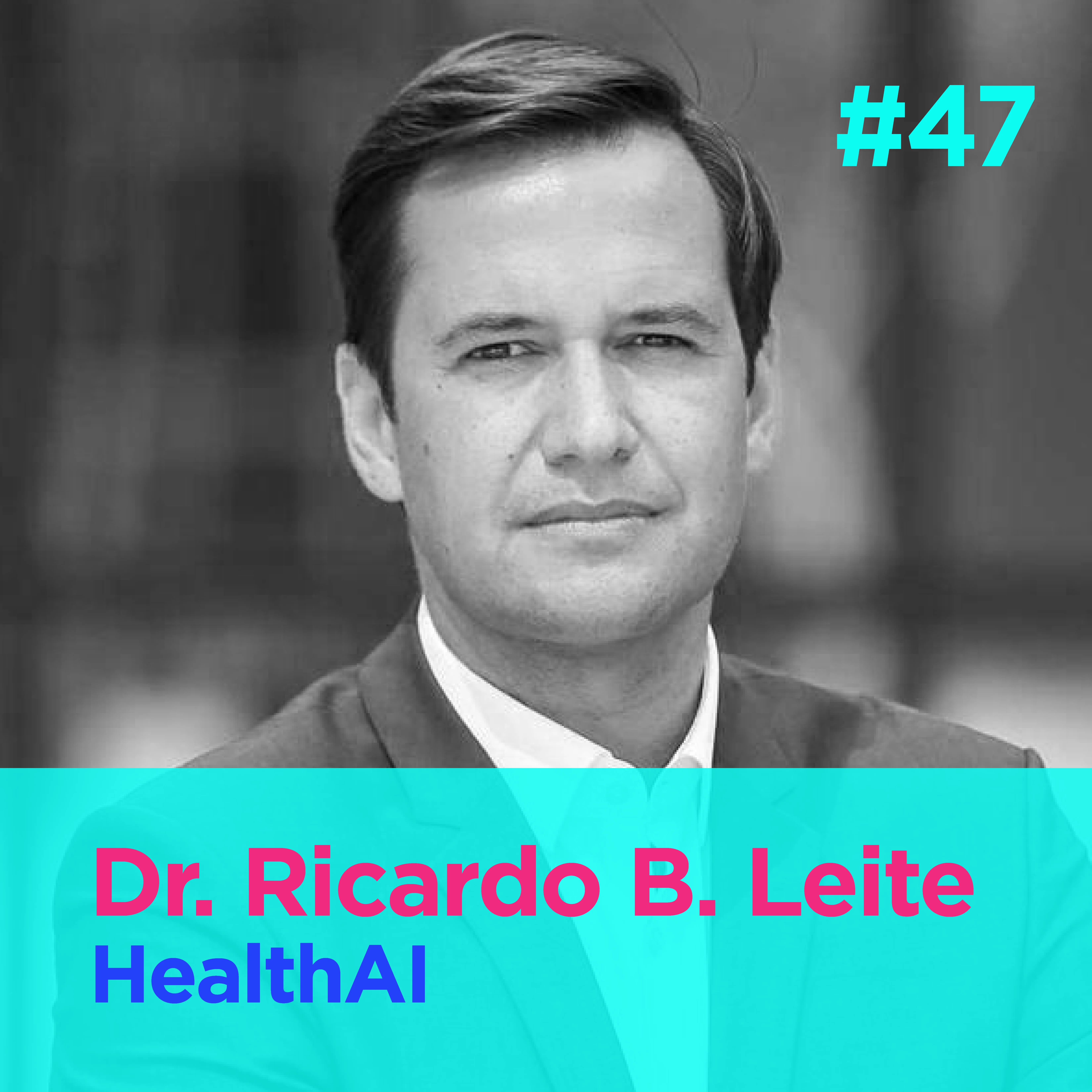
Ricardo is the Founder and CEO of HealthAI, the Global Agency for Responsible AI in Health, dedicated to shaping the future of medicine by promoting ethical AI adoption and key policy across the world.
Episode notes
How can we solve the puzzle of regulating AI in healthcare?
This is the question that Dr. Ricardo Baptista Leite and his team at HealthAI - The Global Agency for Responsible AI in Health ask themselves every day.
Their goal?
To help international organizations, governments, and local stakeholders strike a balance between regulation and access to the latest innovation in the field.
A thorny equation, considering the speed of progress in AI and the time it takes to establish a regulatory framework that, by definition, applies in the long term.
With passion and enthusiasm, Ricardo shares the approach they are taking to achieve their mission: by fostering a global community to share best practices and adverse events, by building tailored
in-country mechanisms aligned with international guidelines, and by curating the most comprehensive directory of registered AI solutions, which countries and innovators can consider.
One thing seems certain: we must evaluate these new technologies from a risk-benefit perspective, drawing on the well-known methods of post-market monitoring that have been applied to pharmaceutical products for decades.
A way to remain critical of their use, grant patients and healthcare professionals access to them, and to drive this transformative shift with confidence and security.
Timeline:
- 00:00:00 - Ricardo’s background at the interface of medicine, research, and health policy
- 00:04:55 - Why we are at a turning point in healthcare
- 00:08:33 - HealthAI’s role in translating international guidelines for AI use in healthcare to local realities
- 00:13:08 - Bridging long-term regulation and rapid technological progress
- 00:21:55 - Curating the right AI solutions in healthcare
- 00:25:55 - Building trust and adoption among clinicians and patients
- 00:32:26 - The parallel between elevators and AI in healthcare
- 00:37:30 - The potential of AI for predictive population health management
What we also talked about with Ricardo:
- HIMSS Europe
- Software as a Medical Device (SaMD)
- Stéphanie Allassonniere
- Agentic AI
- Ambient AI
- Elisha Otis
As Ricardo mentioned during the episode, you can learn more about HealthAI here and follow their activities on LinkedIn, X, Instagram, and YouTube.
The books recommended in the episode include AI Snake Oil: What Artificial Intelligence Can Do, What It Can’t, and How to Tell the Difference by Arvind Narayanan and Sayash Kapoor, Outlive: The Science and Art of Longevity by Peter Attia, and Power and Progress: Our Thousand-Year Struggle Over Technology and Prosperity by Daron Acemoglu and Simon Johnson.
We both strongly recommend the newsletter Ground Truths by Dr. Eric Topol, a reference for staying up to date on the latest advances in medicine.
You can get in touch with Ricardo via LinkedIn.
If you want to give me feedback on the episode or suggest potential guests, contact me over LinkedIn or via email!
And if you liked the episode, please share it, subscribe to the podcast, and leave a 5-star review on streaming platforms!
You can also support my work by doing a PayPal donation @ImpulsePodcast!
Lastly, don’t forget to follow our activities on LinkedIn and our website!
Full conversation
Episode transcript
Generated from the YouTube captions and lightly cleaned for readability. Names and technical terms may contain transcription errors.
Read the full transcript
If we're having humans in the loop, the idea is to improve the technology and to build our trust. We have to avoid falling in the temptation, which is we have a human that provides us a summary and that we blindly approve it because we're under pressure. Which raises another challenge for healthcare managers because a lot of people say, "No, ambience technology and scribes will help us save time in consultations." which means that in the back of their mind to make this profitable, we're going down from the 15minute consultation to 10 minutes. And so the idea that AI can actually contribute to improve the human humanization and compassion in health care is goes down the drain because
you're wasting a huge opportunity to be much more humane in your connection as a healthcare worker with your patient because now you're under the pressure to do many more consultations because you have this AI technology supporting you and so it is our general responsibility as actors in this space to make sure that we do not fall into those temptations or or else we may fall into a situation where we're using AI in a way that is not contributing effectively to improve the quality of care in a way it could if we use AI to rethink and reimagine the health system we want and not just focus on building on top of
this broken model that already exists. [Music] So, welcome to Impulse Ricardo. It's great to have you here in beautiful Paris and you know have some time together during this year's edition of Kim Europe. Um so we'll dive today into you know one of the most dynamic debated and you know kind of like consequential frontiers in in medicine that we hear a lot about you know in today's in in the conference meaning artificial intelligence or AI. Um so there's a lot I would like to cover in the episode with you including how your you know personal experiences across medicine, politics um academia have shaped your vision uh for responsible AI in
healthcare, how you know you think we can balance its regulation to you know enable new solutions for health systems while you know preserving their safety in the quality level. Um how we go or how we go about you know trusting these tools and you know what future developments might might bring. So before we head there and as I as we do in every episode of the podcast, I would invite you Ricardo to present yourself. — Well, thanks so much for for having me. It's a it's a pleasure as you said in beautiful Paris to be surrounded by brilliant minds committed to promoting the power of AI and digital for the
benefit of health of citizens across the globe. Uh my name is Ricardo Batista late. I am the CEO of Health AI, the global agency for responsible AI and health, a nonprofit based out of Geneva, working as a technical partner with governments towards promoting uh governance and regulation of artificial intelligence to scale AI solutions across the globe. My background is as a medical doctor trained in infectious diseases, having served in politics many years in my home country of Portugal. I was a member of parliament for four terms. I was also a deputy mayor and city councelor in my hometown and um I my academic career has been in the space of global health, health policy and in
the frontier with digital and also to add because I maintain my volunteer work in an NGO that I founded in uh 2017
which is the unite parliamentarians network for global health a network of current and former members of parliaments, congresses and senates from 116 countries that are committed to promoting science-based policym for the benefit of health. — Amazing. Um I was wondering you know as I mentioned in the introduction so your career and your background spans in clinical medicine politics academia and now global health AI leadership um I was wondering you know how these kind of like varied experiences that you have you know shaped your vision and also your wish um to get involved you know with AI in healthcare and how we kind of you know regulate it uh from policy
perspective. Well, ultimately everything I've done in my career from being a a practicing physician to to politics to um today at
Health AI, it's always been driven by this vision that um through our actions we can objectively not only react when people get sick, but we can actually work towards a society in which we promote health, quality of life and well-being as as our ambition as a community. The truth is our health systems are broken. We have reactive systems that simply react when people get sick. And the financial incentives sadly are also aligned more with sickness than with health. It is much more profitable to keep people sick than to treat them or to cure them or to keep them healthy altogether. And so there's a need to rethink and reshape the way we
organize ourselves from an ecosystem perspective. Now, artificial intelligence represents, I believe, an a unique opportunity for this transformative uh need of health systems. If you think about it, our health as individuals depends on many factors. The clinical factors that is what the health system looks at just represent 10% of what actually affects our health status. 30% of what affects our health status are genomic factors and other factors that are hard to change. 60% of what affects our health are exogenous factors. Our level of education, where we live, what we eat, the decisions we make every day, the air we breathe. Most health systems don't even look at that. Yet, it affects the vast majority
of the quality of life and wellbeing of citizens. The thing is to address that seriously, we're talking about tremendous amounts of data that no human can alone process. And so AI represents an opportunity to have this big picture approach in which we can actually think how do we want to design a health system of the future that is focused on improving health outcomes of the community at large. Making sure that people live their life with the best quality of life possible. That needs to be our obsession is improving the quality of life and well-being and AI then is our driver for this systemic transformation. The thing is today what we're seeing is AI being retrofitted
into the current models of management which are broken. And so making inefficiencies even more inefficient faster and so it's exactly the opposite that we need to provoke. And that's what we're trying to do at Health AI in the sense that we're trying to help countries build the ecosystem and the regulatory environment that not only ensures the safety of the technology but also the conditions for the technology to scale at the systemic level so it can reach everyone and everywhere instead of what we're seeing now which is a whole bunch of pilots and technology being accessible just to a few who have the resources to have access. And that's why we also work not only in high-income
countries but also in low and middle inome countries that stand to benefit tremendously from the power of technology to leaprog into a future where their health systems could be an AIdriven model. So can you tell us more about how you go about you know providing that sort of like guidance on what to use to kind of like embrace that vision of moving you know away from reactive medicine to more preventive or you know to follow some of the that philosophy that you shared from a regulatory perspective — of course so health AI has positioned itself as a bridge between international
standard setting organizations like ISO WHN UNESCO, OECD, then at more regional bodies like the European Commission. So these bodies are responsible for the publishing guidelines, standards, regulations. We don't do any of that. Okay? We work with what is defined internationally and we're a bridge between those organizations and the national regulators, the organizations that today are responsible for reviewing the technologies that have access to the health system. What we do is we help translate and adapt those international guidelines to the local reality and provide the technical assistance to scale up the capacity of the country to assess these technologies and to implement them. We've developed uh tools within our organization and the most
prominent one is our healthi navigator that provides clear guidance in a very practical way of how do you then translate international guidances into the work I have to do here on the ground and then dealing with hospitals and clinics because one of the issues with AI is everybody's talking about it. A lot of organizations are presenting guidelines and policy pieces but it's all very much 30,000 ft up in the air. We need to get on the ground. We need to get our hands dirty. And that's what Health AI proposes to do. And so we've created a concept which is the global regulatory network. And we're starting with 10 pioneer countries which will be
announced after the summer. And so those first 10 countries are going to be the first 10 countries where we will be providing this technical assistance and taking these countries down a maturity journey if you will in terms of improving their maturity from an AI regulatory perspective. And these pioneer countries as we call them will have access also to two important tools. One is the global early warning system. So as countries register incidents related to the use of AI, let's imagine a a risk or a harm that is detected in one part of the world, all the other regulators get a red flag in real time, allowing us to act early on, building
trust in this postmarket surveillance approach, but also helping companies detect problems early on, avoiding reputational risks, avoiding legal liability. On the other hand, we are uh developing a repository or a directory if you will of AI solutions. So you can think of it as a global marketplace. As the regulators approve the tools for their country, those tools will appear on this platform that will be a global public good. So you'll be able to see what technologies are out there, who developed them, and which regulators for which countries have already approved them. And we believe that this will help these technologies expand beyond the markets. So even technology developed in low and middle inome countries will
stand a chance to be able to expand even to the global north. — Yeah. Interesting. You know I think it's kind of like reassuring to me that you know agencies like you know healthy exist because I have the impression that everybody's like talking about it. We we see it, you know, in conferences like HIMS for example and myself, you know, I get to use some of these tools maybe not necessarily like applicable for in terms of like healthcare specifics, but and I kind of like worry sometimes that we just we actually don't know exactly how these things work. We might not have the access to let's say the expertise to
understand these you know these tools like in depth and that this sort of like partial understanding might not be sufficient to inform like you know regulatory decisions um that you know ultimately apply over like long periods of time and you know over broad scope of you know use of use cases um so I think it's kind of you know reassuring to to me that you know your your agency is is around um I think the the followup question I would have um was you know to me regulation and AI they kind of like differ in nature because on one side you have that kind of like technology that evolves very very quickly um there's
also can like constantly mutating and on the other side we need to you know come up with rules and and guidances that you know take some time to be you know well thought through and um and that also need to apply over long periods of time that might not you know kind of like reflect the base of of how technology evolves. How do you kind of like you know in in your work with healthi how do you go about kind of like bridging these two worlds or accounting for these sort of like two let's say time time references in a way. — Yeah. So there is this um contrast typically in when you talk about
technology which is many times the innovators believe that regulation will hold them down. Yeah. And bring them back. While the regulators believe that the world will collapse if they are not if regulations are not put in place. Um I I think that the virtue is right in the in between in the sense that we need a regulatory environment that promotes innovation. And what I mean by this is unlike other sectors of our economy, the health sector is one where technology will not scale if we do not have the right governance in place. And there are many reasons for this. One is the issue of trust. You need governments or insurance companies to trust the
technology to adopt it. You need the physicians, the healthcare workers to trust the technology to use it. You need the patients to trust it to use it and to to to accept it uh to be used. And so
without addressing that trust issue and I normally give the example that we use at at health AI which is the idea of the paracetamol when you have a fever uh when you give it to your kid you don't think twice with AI you're still thinking twice about the technology because we have not reached that point of trust that is fundamental for the technology to be used in an ubiquitous way across the system. The other the other issue that I think is is critical is getting people not only to trust the technology but also to reimburse the technology because the truth is companies are spending million billions if not trillions in the development of
AI but the reality is somebody has to pay for it and today you have a lot of pilots out there but you don't see many scaling to this systemic level and you don't really see processes in most health systems that allow you to determine the value of the technology and to reimburse it especially when we're talking about AI that does not fall under your medical device definition which is a more I would say in at least in Europe and some several other high-income countries pretty well reggulated space very well defined so software as a medical device actually is pretty advanced in many contexts not around the world but in many contexts
So the idea is how do we arrange a model where you can reimburse technologies that go beyond that classical definition of medical device without cracking that nut. It's very difficult to see these technologies uh scale. And so you know those are two of many challenges but as what is clear from this I believe is that health for health innovation to scale to have impact at a systemic level you have to solve these underlying governance issues.
There was an amazing company that I I got to see the technology they've developed in imaging in in the field of breast cancer. One of the most advanced things I've ever seen. The company went to bust. They went bankrupt because the country where they were operating said they would take seven years to assess the technology before reimbursement. That is not compatible to the venture capital funding that is behind many of these models. Right? And so you need governance systems that keep up to the speed of the way this technology is evolving. I am a strong believer that and you know we want to help countries in this direction which is the initial
assessment of technology is important but even more relevant in the future of AI will be postmarket surveillance making sure that you detect issues as you move along there's this false idea that you know with humans we accept any kind of failure with machines it has to be — perfect that is a false perception what we need to assess just like we do with pharmaceutical products is risk versus benefits. And if that ratio plays in the favor of humans, then we should go with it. But having very strong postmarket surveillance systems to detect if something does go wrong and to detect it before harm at scale happens. So this is an evolution of thought that takes time
and so that we're trying to hopefully accelerate with all of the tools we've developed. And so with these first 10 countries, it'll be a mix of high and middle and low-income countries from Latin America, Africa, Europe, uh Southeast Asia and and Middle East. With these countries, we will have, I would say, a a very important testing ground of these frontline uh countries that will be taking the lead. And all the work we're going to do today will certainly be different from what we're going to be doing 2 years from now because it has to be a journey and we have to be flexible. The technology is moving extremely fast. So being able to
adapt as the technology evolves is critical but also we don't come in with a one-sizefits-all approach and I think this is very important. What we do is when we start working with the country, we assess the needs of the country, but also what are the ambitions of the governmental leaders and the regulatory leaders and so we adapt and tailor our
technical assistance to that reality. So if anyone comes into this space saying everyone has to follow the exact same rules in the exact same manner it's failure from the start right out of the gate because you're dealing with cultural differences you're dealing with ideological differences at the governmental level at the local level you really need to have a spirit of diplomacy dealing with this issue to make sure that you are slowly aligning the world in a certain direction while respectful of each cultural reality but at the same time building sovereign capacity and so I think this is ultimately a way of building resilience of health systems because it's not a
Geneva based organization coming in and doing the validation for the country what we're doing is building the capacity so the country is autonomous and so this is critically important in a high-income country but you can imagine how important it can be in a low and middle inome country even to attract investments and to make sure that the technology is being used in a responsible manner and so we we're very excited to be able to and we believe that by the end by the end of 2026 we'll be able to showcase many of those results as use cases. So far um you know you mentioned earlier um sort of like discrepancy between you
know those who are very much let's say favor of these tools some who are very much on the let's say more cautious side um I when I was preparing you know for the the conversation one thought I had was um you know and you mentioned that in terms of you know different government style of leadership when it comes to these types of solution solutions. Um, and I guess one thing that we hear a lot, let's say in Europe where it's already, you know, we're already kind of like heavily regulating the field versus maybe what we might see in the US or in China and other places of the world where, you know, regulation
could kind of like, you know, put us in a situation where we might not have access to the latest tools. the the clinicians might not be equipped with the the best solutions available due to regulation and uh let's say constraints. How do you see you know your role as you are you know operating you know globally supporting a lot of different countries that have lots of different types of ways to approach these solutions. How do you see your role in maybe managing that sort of you know differences in terms of access to the solutions based on the different regulations? Well, let me just um maybe just disagree in part with one
thing you said. Um because uh in reality, if you look at what is happening on the ground, not what politicians are saying, but what is happening, — there's actually very strict regulations of medical devices in the US under FDA and even in China. And so sometimes there's this false perception that there's no regulations in these countries. — Yeah. the the US is the country that has uh assessed and validated most tools in the world through a regulatory process. Uh they have a published list of around 1,000. Some of them are duplicate or a revalidation. So we're talking about around 600 tools. But ultimately just to say that the idea that there is a lot of
regulation here or none there is not actually the reality. However, um there is uh there are differences and you know and those differences evolve and political leadership can change the priorities and so you're right that is a very difficult space to navigate sometimes as I said before you need global health diplomacy in a way and technological diplomacy to deal with it but also um you need to make sure that your mission in our case our mission At Health AI is focused on the end game and the end game for us what our final output always has to be is is what we are doing contributing to improving the health of citizens
everywhere every every citizen everywhere and you know to respond to that you need to listen to the citizens you need to listen to the patients and that became so clear to us that we decided to create a community of practice that involves now already 25 governments but also academia. It involves international organizations, private sector partners, but also uh civil society movements and patient organizations. This community gets together online uh every other month and to discuss the issues around the governance of artificial intelligence at a global level to reflect how the governance and regulations are impacting their lives, how AI is impacting the work they are doing, how they believe we
should be moving in in a certain direction moving forward. And so this community is growing fast. It started in December already has more than 300 institutions as part of it. uh any organization that is interested can apply to join on our website at healthai.ag and it really is to create that space because in reality we have to be sensitive to these difference to this to those differences on the on the ground and ultimately not forget who we're serving. You know it's very easy within health systems to think we're serving either the healthare workers or the political needs. Ultimately our our our aim has to be to say serve the people be
it citizens who we want to prevent from getting safe or the patients who we need to make sure get better and this is something that is very core to our heart and uh we hope that this community will continue to grow and give us the feedback to keep us grounded in our mission. So you mentioned also earlier the aspect of you know trust uh when it comes to printing these tools for you know clinicians for patients for you know basically everyone involved in their healthcare system um you know what are let's say concrete steps from your perspective um that you know I would say developers and regulators you know need
to ensure so that this trust is you know kind of like built towards the end users um that these solutions will be used by um you know is I guess there is a role of you know in terms of educating or reassuring on what the real risks are or I'll be curious to hear you know from your perspective how you how you go about that. — Yeah. So building trust is a is a long process of course but we are I believe creating mechanisms in that direction. One is our inclusive process of developing the governance ecosystem through the community of practice which I already mentioned but also when you think about for example the postmarket
surveillance process having a tool that allows you to identify early on potential risks or incidents and share that information globally it shows openness and it shows our capacity to detect problems early on — which means that I'm using the technology with the conscience that there is the system behind me that will detect if something goes wrong early on before it turns cause harm. That kind of monitoring system is one that I think has been critical in the pharmaceutical field or even in the medical devices field that we need to continue to build on as a as a global mechanism that certainly will help us build trust but also at the domestic level at the
national level making sure that the those entities responsible for assessing the technology be it at the regulatory side be it at different levels of governance of the government and of the health systems that there is the capacity to understand the technology and to pass on the proper guidelines and training of all those involved in the ecosystem is critical because if you will you will always distrust the technology you do not understand and so if we say that the citizens the healthcare workers the managers they have to trust the technology well then we have to proactively provide them with the right guidance and and capacity strengthening in that direction and so
that's all part of the different pieces of the work that we're providing and It's an effort that every every government, everyone leading health systems across the globe has to have as a a top priority. The last thing maybe which is le is more subtle but I think extremely important is we need to learn the lessons of what did not go well with the digital health transformation. As you know digital health is the main cause of burnout among healthcare workers in many parts of the world. dealing with electronic health records is such a hassle many times and the benefits are not always clear for the patient and for the healthcare worker. And so I saw that you know in
firsthand when we went from paper to digital and seeing how it just took us more time with no benefit at the end of the day, right? And that cannot happen again. So being able to use AI that actually addresses challenges in an innovative way helps us redesign, reimagine the health system of the future to be focused not on disease but on on that on health and well-being but doing it in a way where you're not forcing people to use a technology because you developed it but developing technology that can help contribute to that reimagined system. It's a completely different mindset and I think if we are able to do these different
things perhaps we will build not only the trust but also the willingness to use the technology and that I think are fundamental principles to scale the technology there are other barriers we haven't spoken about but just to say that especially in low and middle inome countries then you have issues that are also additional barriers that make it hard to adopt technology be it electricity — be it in terms of access to internet. And so I'm a strong believer that technology that can be low energy cons consumption that can actually use renewable energy to to to make it work that is low code on device with no need for constant internet connection. This
is the this is the world in which I believe AI will become uh a reality in our day-to-day lives in a way that today we we're using AI and Google maps or whatnot uh without thinking about it as AI we have to move in that same direction with health despite health being a very technologically prone area the adoption at the patient level many times is not so fast as we see in the financial sector for example so that Those kind of changes of mindset I think are critical to so that innovators can also design technology thinking of the person at the end of the the value chain who has to
benefit from it. One last thing, sorry, but I I think it's important because you mentioned innovators. Our healthi navigator has been designed precisely to support the different stakeholders on addressing the challenges of of AI, right? And so as a navigator, it brings together all the standards and regulations and it's been designed for regulators, but actually you can access the same information with a different lens. So if you're a policy maker and you need to write legislation or if you're an innovator, you can also access it. So you can design from the conceptualization of an idea all throughout the the machine learning ops and life cycle. You can actually include the vision of how should I build the
technology so it is aligned with the standards and regulations which will improve probability of success to access to market. And so this is also an additional step I think that will be fundamental to to accelerate the adoption of these technologies. In one of the talks this morning um we heard professor Stefania who you know which is focusing on was focusing on the potential of agenti tools in clinical decision making and you know how these solutions might you take a growing let's say decision making and operational role to support clinicians in their work. um what are your thoughts on you know this use case in particular and you know what are some
of the regulatory or let's say maybe even like ethical challenges that these pose because I kind of understand it this is kind of like the evolution of for now we talk or we hear a lot about LLM and other let's say technologies
that are more let's say common now uh or ambient you know AI tools that enable clinicians to you know have notes directly be written from consultations into the electronic medical records um where they play a kind of like a an assistant but it's kind of like a an advising role and they are not driving workflows or protocols in the background. Um how do you see this from your perspective? — So if you look at the evolution of technology over the last few centuries the trend is always the same. You start with people not using the technology, then some early adopters pick it up, but nobody wants to fully automate, right?
And so then you go down a journey that ends up at a certain point with extreme automation, right? Um I love elevators as because they're a good story where you see how first of all people were not convinced about they were afraid to use elevators. Elias showed this at the World Fair in 1853, showed his working elevator and put himself on top of it in the middle of the World Fair and asked his assistant to cut the cable and the elevator, used security brakes and people were odd and they started to trust the technology and they started building skyscrapers in New York because they could trust the elevators. But we included elevator
operators uh for decades, people to press the button for us because we were afraid to use elevators without a human intervention. But then you know actually the elevator operators went on strike in the 1960s and then people understood they could use operate the elevators alone and they lost their job forever. But that being said, I think the parallel there on how technology evolves is not very different. And so the way I see it, I think a lot of the tasks we do will be automated down the road. And that's not necessarily a bad thing. It's just the evolution of technology. We just need to make sure we're doing it in a way that
is safe and effective and that contributes to improvement of health outcomes. I think it'll take some time in healthcare. It'll take longer than other sectors for obvious reasons um because we're dealing with human lives here. And so until then I I I see
regulators probably playing a role where they prefer to deal with what we call static AI and and you know any improvements to the models should be resubmitted for approval. Um so kind of
ML on the fly I don't see it happening immediately. It will happen eventually particularly when I when we can imagine a future where AI will be supervising AI in terms of postmarket surveillance. We are far from that I would say at this point and then you have a sociological issue which is can we trust a human to do c make certain decisions for us. I think we'll see we'll keep the human in the loop for a long time until humanity feels comfortable with many of those tasks being completely outsourced uh to machines and maybe that's not a bad thing. I mean it allows us to perfect the machines to identify mistakes to
make sure that um that we're go going in the right direction. What does concern me though is human nature in a way because I remember back in the days when I was working in the emergency room, you know, these machines came out with a AKG machines to to do your AKG and they used to have these systems. It wasn't even AI, but it would provide you a report based on the pattern of the line. And you know, of course, if you look at actually how good it was, it was not that good in terms of sensitivity and sensibility. But the fact that a machine put out a potential interpretation, I I mean an a high percentage of
physicians would blindly follow the machine that they would not even look at those lines. And maybe it doesn't there was no match there, right? And that's what concerns me, which is if we're having humans in the loop, the idea is to improve the technology and to build our trust, we have to avoid falling in the temptation, which is we have a human that provides us a summary and that we blindly approve it because we're under pressure. Which raises another challenge for healthcare managers because a lot of people say, "No, ambience technology and scribes will help us save time in consultations." which means that in the back of their mind to make this
profitable, we're going down from the 15minute consultation to 10 minutes. And so the idea that AI can actually contribute to improve the human humanization and compassion in healthcare is goes down the drain because you're wasting a huge opportunity to be much more humane in your connection as a healthcare worker with your patient because now you're under the pressure to do many more consultations because you have this AI technology supporting you. And so it is our general responsibility as actors in this space to make sure that we do not fall into those temptations or else we may fall into a situation where we're using AI in a way that is not
contributing effectively to improve the quality of care in a way it could if we use AI to rethink and reimagine the health system we want and not just focus on building on top of this broken model that already exists. I guess in your daily work with healthi you're in touch with a lot of you know obviously companies who are you know kind of like pushing for a lot of very innovative use cases that you know leverage AI and other similar technologies. Um are there any you know use cases that you've come across recently and also maybe from your physician perspective that you know are kind of like maybe the you know have a lot of potential in a
way and that's not let's say covered by yeah the let's say the most heard of terms that we hear in conferences these days around healthcare. Well, working in the space, the the magical thing is that you're hearing new things every day. And um and I I'm surprised by innovative leaders coming uh in the field thinking about angles to problems that we've had for decades in a way that is truly original. And there's almost a democratization of possibilities of innovation that AI has opened up. Um if you look at the AI technologies that exist, you can see it already throughout the whole value chain, right? from research and development. So AI is
extensively being used in the discovery of new vaccines of new pharmaceuticals. During COVID, almost every pharmaceutical company do that developed vaccines that went to market had used AI in the process of R&D. But then if you think about manufacturing, logistics, uh all important things that we tend to forget, AI is now being used extensively. Um in in the healthcare setting, of course, from diagnostics to treatment across the board to virtual assistance to describes. Um if you think about robotic surgery, it's a huge area in expansion. Um beyond that even postcare uh monitoring uh assistance that keep people on on their treatments in terms of adees treatment um population management AI predictive
analytics used in for public health purposes for epidemiological surveillance uh for identifying potential candidates for screening or for vaccination um or even in more mundane tasks. that are not clinical but extremely important like finances, auditing, uh financial fraud detection, um claims. AI is being used
in every area that you can think of. The thing is you're ending up with so many pilots that it's a problem. The area that I so I think that out of the pilots, we have to see the ones that are truly affected and help them scale and create that ecosystem for that. Out of all of the areas that I've aforementioned, I think that the area that I've seen starting to grow but is less under the radar is clearly on the prevention side. So, how do you use predictive analytics at the population level to detect people who are still what you could consider healthy but at higher risk, for example, and being able
to proactively uh reach out to them and avoid them going down a path that will inevitably lead to some form of disease, prolonging their life with quality of life and well-being. That's an amazing future. And and of course, that then goes down the path of personalization. I I'm a strong believer that the in the future in the clinical setting I grew up learning that treatment should be based on guidelines. I think the future is a future with no guidelines where everyone has the potential of being treated at a hyperpersonalized way. So what works for patient A will not necessarily work for patient B or not in the same way. This
idea that one pill in the same dosage will work for every adult in the planet will be something of the past and that is there that that's a potential that's real. It's one we have not explored sufficiently I think uh but I think it's actually part of the the the most exciting components of this AI revolution that we have at hands. Once again the there's so much money invested in the current model of care. The incentives are so line in in sickness that it really will take inspirational strong leadership with visionary uh capacity and strategic uh capacity to
step in and say we're not going to continue business as usual. We're going to use the intelligence revolution to transform our system altogether. — Yeah. No, I appreciate the the nuance I guess that our conversation brings because I think you know we discussed in the beginning that there is a we we hear a lot about you know our regulation we hear about you know those in favor those against it um I appreciate as well I guess the position you come from um you know yourself but also with Ali where you're under the service of you know health systems governments and manufacturers to you know work out what might be best for the population or the
regions where you know you you where that you support. Um so I'm also you know conscious of your time and I'm really appreciative of the the time you take during the conference to to have that conversation with me. Um, you know, one of the recurring questions we ask to every guest on the show is, you know, what what resources would you recommend, you know, our listeners to check out, you know, to know to know more about the work you do, but also maybe more generally, I guess, AI regulation in healthcare, be it, you know, books, publications, websites. Are there any that you would like to to recommend? — Well, every summer break, I so starting
last year, hopefully next summer break, I'll do the same. Uh I I felt the responsibility of publishing a thread on my social media so people can find it in my social media in last August. Um a list of books that I recommend in this space. I'll be doing something similar this year. Um and there are many publications so it's hard for me to pinpoint. Um so right now I'm listening to an interesting book uh called AI snake oil. which is an interesting book uh around this topic of you know how do you distinguish what works and what doesn't uh you start reading the book and you feel it's written by people who think
regulation are necessary but then as you go along it it becomes very clear that they believe that technology actually is good we just have to make sure that there that the bad snake oil that is being sold is removed from the market and right now the truth is we don't have the governance mechanisms in place many times to distinguish what works and what doesn't. And so a lot of companies are selling things that actually do not work and we don't have ways to make sure that the people who make those decisions have the tools in hand to to make those conscious decisions based on on reality. So that's an interesting book that I I
I've come across. The book of the year for me last year, this is completely personal, was a book that has nothing to do with AI. It was called it's called outlive — yes it's very interesting — I found it to be extra extra extraordinarily interesting and if you read it from an AI perspective which it was not the angle of the author you can clearly understand the potential to save humanity from a a a diseaserridden future but to one where we can live longer healthier lives um where quality
of life and well-being are are central and we're both here in Europe uh in Paris in the heart of Europe and the oldest continent in the planet longevity has not necessarily come with quality of life. the last years of life on this continent are not lived with the with the well-being that could be possible and so we don't want that future right and so it's in our hands to avoid it and AI can be the driving force to get us there but once again we need leadership who knows where to go because if you don't know where to go any path will take you there and that's not necessarily the best way to move forward
I believe that with strong visionary leadership we can move in the direction where healthy lifestyles and well-being can be a reality for everyone everywhere including in low and middle inome countries and that's what drives us at healthy — amazing we'll put all the links in the show notes and you know I cannot also recommend enough of leave by vidia I think there's probably few let's say doctors with his level of influence that embrace that you know pro kind of like proactive prevention and medicine 3.0 Oh, as he has he know that explains it. Um, so yeah, hopefully um could you share with us you know an additional anecdote maybe from your work
at LFI that you know made made you realize the impact that you were having on people's lives knowing as well that as you mentioned the next big the countries will be announced in a in a few months but I don't know if there's any any other story you would like to share with us. Well, it's interesting to see as we step into countries and initiate, you know, the the training processes. We just had a team who was in Argentina. Before that, we had a team that was in Tanzania and Zambia. Um, in our community of practice, we've heard amazing use case examples coming from countries as diverse as Brazil and
Singapore. And what I can tell you is that just the fact that we're bringing these different con countries and regulators and governments together along with the more broader community of practice. We're seeing very serious conversations about this is what we're doing but we are facing challenges and no matter if you're rich or poor from a country perspective many of those challenges actually overlap and that's been for me one of the greatest revelation relevations which is when you see that a country on the continent of Africa a lower a middle inome country with its context and all of its challenges when it comes to data data when it comes to AI adoption when it
comes to having the governance system to assessing technology and how do I reimburse it even if they had all the money in the world they would be facing the same problem as other richer countries of the world that also don't know how to address that challenge and so there's almost a a sense of commu a
community uh where we're all part of this revolution and another book uh is called power in progress that looks at the history of technology over the last thousand years and almost consistently what we have seen is that technology promoters those that develop innovations have always promised that the technology will solve the the problems of humanity but almost always it has led more to the concentration of wealth and power. The few exam exceptions to that was when the technology was designed from the start to address the issues of equity and inclusivity putting human rights in a way front and center and
equity is actually a good business model because it expands the number of markets that your technology can expand to. So equity and inclusivity can go handinhand with profitability. And so now that we're at the beginning of the AI revolution, of the intelligence revolution in health, I think what we're seeing is the potential is there. And I think that's one of the greatest takeaways of our community, our young community of practice, is that the potential is here for us to optimize the governance models so that the technology can scale in the right way to benefit everyone including those that are developing the technology. And so it's a very exciting time to be around and to
be part of this and knowing but also a huge responsibility because we know it's on our shoulders to get it right. — If you were to recommend um a fellow healthcare innovator as a potential guest for the podcast, you know, who would that be and why would you recommend her or him? Maybe not necessarily, you know, in the regulation space. — Well, we already spoke of the author of Live. He would be a great person to listen to. I'd love to hear his perspective on AI given his proactive views on on artificial on on on
prevention. But I would say also uh well if the sky's is the limit and you could reach anyone um I think it would be useful to listen to Eric to Paul from ground. — Yeah. because he he truly has been um a leader in in this field uh putting science front and center in this discussion and understanding the power of AI transformation and so um he's someone I also follow very closely and I think is worth following and um and brings the right perspective at the end of the day we need science to drive our decisions. Yeah, also follow and read let's say very yeah thorly's ground truth newsletters also you mention it in
the in the description and as you say it's very much you know science-based but also like I guess readable by people who are not necessarily doctors or scientists or um so yeah very valuable resource hey thank you so much for your time you've been very very generous with your time um was a very interesting conversation I think know I'm looking forward to hearing the feedback from listeners but Yeah, very warm thank you from. — Thank you. Keep up the good work. — Thanks for watching the episode. I hope you enjoyed it. You can subscribe by clicking on the podcast channel at the top right and watch another episode here at the bottom.