17.11.2025
#53
Simon Mackenzie
Cellbricks Therapeutics
Engineering living tissue therapeutics
Listen on your favorite platform:


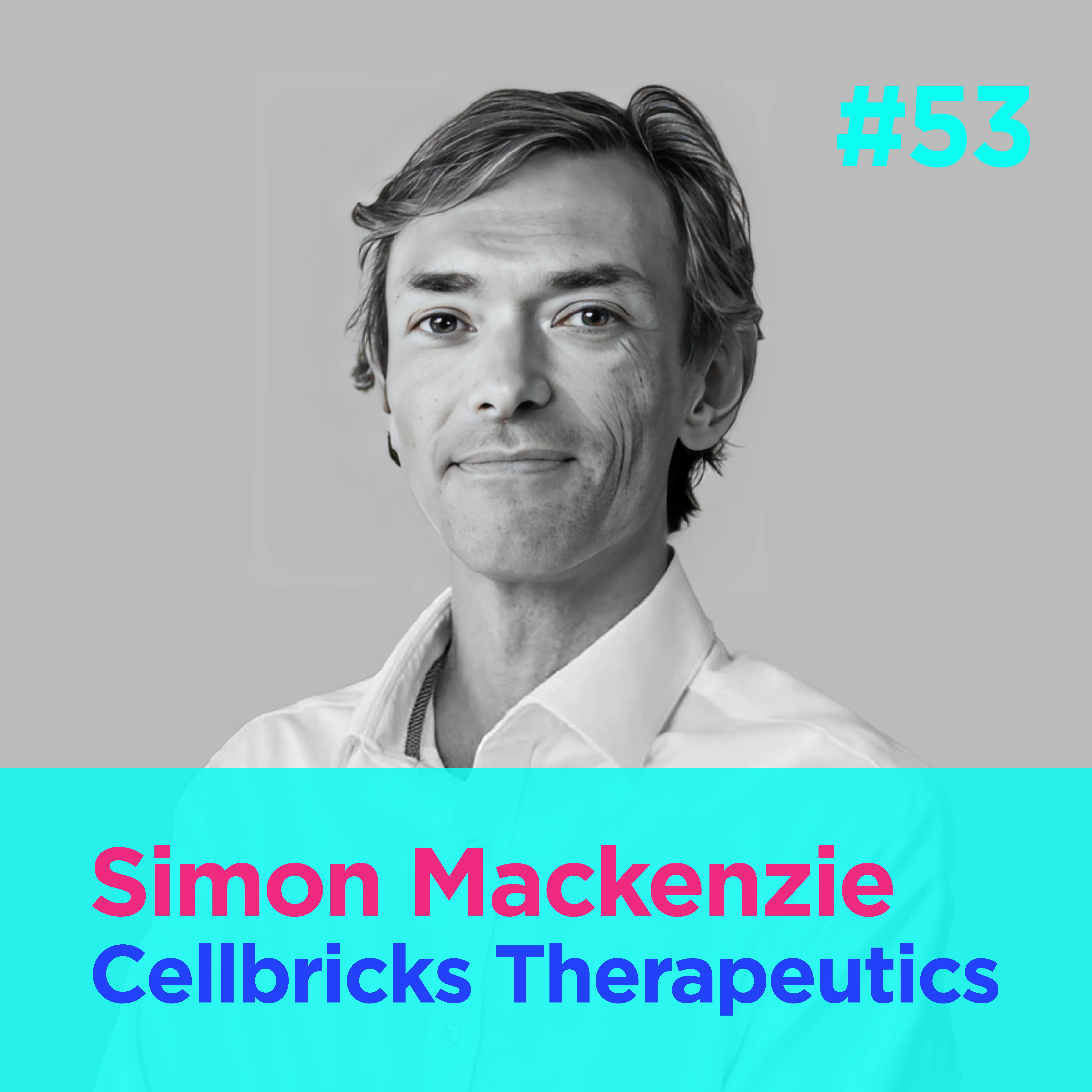
Simon is a Biotech Leader and CEO of Cellbricks Therapeutics, a company focusing on light-based 3D bioprinting to construct complex tissue models, driving transformative solutions in regenerative medicine and personalized patient care.
Episode notes
Is there a future where we will manufacture entire organs?
If that's the case, it’s not tomorrow.
Yet, the era of regenerative medicine and tissue engineering is very much real and happening now!
In some fields, like in dentistry, we are already 3D printing implants that are placed in patients' mouths.
In others, like in orthopedic or plastic surgery, cells are harvested from patients to be modified and placed back into their bodies.
But what we can't do yet is create complex, functional tissue constructs that can actively remodel and integrate with the human body to restore physiological function.
This is the challenge that Simon Mackenzie and his team at Cellbricks Therapeutics are striving to overcome.
The technology they have developed is fascinating, sitting at the crossroads of biomaterials, cellular engineering, and 3D printing.
A discipline that aims to create the first "tissue therapeutics."
The prospects it opens up are incredible: building grafts to heal complex wounds, functional implants for the liver, pancreatic islets for insulin production, and much more!
In this episode of Impulse, we explore the inner workings of this fascinating field and the road ahead before the first tissue therapeutics are used routinely in the clinic, from a technical and regulatory perspective.
A thought-provoking conversation offering a glimpse into what a truly "regenerative" medicine could look like in the future!
Timeline:
- 00:00:00 - Simon’s background as a Biochemist and seasoned executive in the life sciences industry
- 00:08:28 - Defining bioprinting, biofabrication, and tissue therapeutics
- 00:12:56 - Cellbricks’ mission to recover tissue loss thanks to engineered tissue therapeutics
- 00:20:52 - Current evidence on the therapeutic potential of biofabricated tissues
- 00:24:55 - Cellbricks’ biofabrication platform to engineer living tissues
- 00:30:33 - The challenges around the transport of biofabricated tissues
- 00:35:36 - The path toward broad use of biofabricated tissues in medicine
What we also talked about with Simon:
- Erik Gatenholm
- Cellink
- BICO
- Aspect Biosystems
- Daniela Marino
- Cutiss
- Organoids
- L’Oréal
- Lisa Anderson
- Paragonix Technologies
As suggested by Simon during the episode, you can learn more about biofabrication and tissue engineering on the Advanced Regenerative Manufacturing Institute website.
You can get in touch with Simon via LinkedIn, and follow Cellbricks Therapeutics’ activities on their website, and LinkedIn.
If you want to give me feedback on the episode or suggest potential guests, contact me over LinkedIn or via email!
And if you liked the episode, please share it, subscribe to the podcast, and leave a 5-star review on streaming platforms!
You can also support my work by doing a PayPal donation @ImpulsePodcast!
Lastly, don’t forget to follow our activities on LinkedIn and our website!

Full conversation
Episode transcript
Generated from the YouTube captions and lightly cleaned for readability. Names and technical terms may contain transcription errors.
Read the full transcript
We can now take cells from those patients and we can generate stem cell lines unique to that patient. We can expand them. We can turn those cells into the the organs or liver cells or kidney cells. So the next step would be then putting all these together with the patient's own cells and creating a new kidney for them which as you know there's a huge demand a huge shortage of organs for transplantation. So that I think is the I think it's unfair to call it the moonshot probably more like the Mars shot but that is what we all work towards and that is is the goal that brought me to to Cellbres and that is
what we mean by tissue therapeutics. It is a therapeutic piece of tissue or eventually organ that would be transplanted or implanted into the patient to recover loss.
[music] So hello Simon and welcome to impulse. I have to say I've been you know looking forward to um to this episode uh for a while now even actually before we we were in touch. So uh for those who know me, I studied biomedical engineering um at EPFL in the specialty I took. Uh during my master's degree was regenerative medicine. So it encompassed subjects like you know biomeaterials uh stem cell engineering and you know we had different research projects where we were trying to you know combine synthetic materials sometimes 3D printed um with living cells and tissues and I still find it's one of the you know the most exciting fields of research in
medicine and although I've been kind of like away from it for some years now I' I've been wanting to cover the topic on the podcast since the beginning um to understand you know the most recent progress we've made in this space and you know to be fully transparent I was in touch with um someone you probably know uh called Eric Gatenholm you know he was the founder of Cell Inc which then become Pico and we had agreed on the recording date a few years back and we unfortunately had to cancel you know close to the agreed date and we actually didn't manage to find another time until he stepped down of the company in 2024.
So you know all of this to say that I'm really glad that you know I came across your work um there that you're doing with subres and I'm delighted that you know having someone like you on the show with whom to dive into the world of biorinting and the fabrication of living tissue but before you know we dive into these topics and for those who might not be familiar with you um just yet I would simply ask you Simon to present yourself. — Absolutely. Thank you Matthew. Um, so my name is Simon McKenzie. Um, I'm a biochemist by training. I've worked in many different areas of life science from drug discovery with small molecules
to proteins to setting up service businesses. Um, but where I've really um focused most of my effort has been in trying to help young companies develop and grow and particularly in the space that we're going to talk about today. And that's encompassed um building uh companies that are in cell therapy um stem cell companies, biioaterial companies and also companies that build bio printers. and bringing all those together brought me to Selbricks. — And what drew you initially to this field of like tissue engineering and you know this because it's quite a specific let's say part of the I would say medtech business. Um — yeah I think it's very interesting you
brought up Eric now bioprinting or 3D printing. So 3D printing in biology had been around for quite some time, but I don't think it really identified what its niche was. And yes, people could say absolutely one day we will print organs. And that's a great goal, but in reality, it's like trying to put someone on Mars, the number of different technologies you have to bring together. — And most of those technologies until very recently just didn't exist. — So there was really a limit to what you could do. So um I was involved in a lot of the enabling technologies being built. So stem cells um I worked in a number of companies
where we've started off with embryionic stem cells and then went to IPSC's and that really was for building disease models. So the idea being creating micro tissues, something even just 2D to start with, something that gave you something more physiologically relevant than a a standard 2D cell model that might allow your therapeutic program to be able to be predicted better for success in the clinic. And then of course 2D wasn't enough even with these expensive cells. But the problem was that the whole process was incredibly expensive. So it was only used at very late stages and for a lot of people it just wasn't possible to do that in terms of finance
or or access. So I could see that stem cells have come a long way and now are such a routine tool that we everybody uses them. Um but then a lot of these other technologies you also mentioned biioaterials again biomeaterials have been around around for quite some time but as a tool as a research tool absolutely people can try and formulate new things but when you actually then move it to start to become a product it's a very different mindset and a very different set of science that needs to be involved. So biomeaterials starting to come together, cells, I was building these complex cell models. Um I was then lucky
enough to move to Switzerland where I helped develop a biorinting company. So this was an engineering company. All we focused on was the hardware and the software. And there my role really was to try to understand what was the market for it. And I come back to Eric. So Eric
with Cell ink to start with I think was in the first wave of biorinting and this where everyone wanted to try and do bioprinting and he was able to democratize he was able to um I guess the main mover for this access to these lowcost or lower cost bio printing systems. Unfortunately I think what people discovered is it's a very complex thing. So there was lots of interesting research but really didn't move to application. — So when I came across Cell Bricks what I felt was the pieces of the puzzle to do tissue therapeutics actually potentially existed and Cell Bricks had the pieces of the puzzle. They maybe hadn't focused
or they weren't using them quite all in the right manner but I felt that was possible. and the board and the senior team at the time said this was their ambition and I thought someone's got to do this and having been in all the periphery and all the different technologies leading to we call it tissue engineering um I thought it was worth a goal so this is where I am and what I do — really cool and we'll talk about you know how all of this works in in a moment I think what's important for maybe the listeners who might never have heard about you know bioprinting Um there's you know some terminology I'd
like to go through with you. So yeah um what you know how do you define bio printing? I think when I check on your website you know you also mentioned bio fabrication. So how it relates to the printing aspect and then the broader you know um let's say term that you also use I think with cells which is tissue therapeutics. So delivering tissues as therapies. I think it would be great if we could you know define these three terms. — Absolutely. Well, bioprinting and bioprinter. So, bioprinter is to me an instrument. It's a tool. And bioprinting is the function of creating um cellular constructs, threedimensional cellular constructs. There's many different types
of bioprinting technologies out there from s things like extrusion where it's like a syringe that squirts very fine um streams of cells or biioaterials into a dish or a plate. Then there's other technologies like we have which is light based where there is a a light sensitive cross linker within the bioink. Light shines into the bioink and where the light shines you harden. So the idea for bioprinting or 3D bioprinting is to create 3D cell constructs based around some form of biomeaterial type scaffold. — Yeah. — And then from there that is one part of
the process which is biofabrication. So biofabrication doesn't just involve the bioprinter. It also involves the cells that you're going to use. So these cells come from either a patient. So they are primary cells from the patient itself or they are coming from a stem cell source and you have to expand them to a certain quality and a certain standard. You also have to formulate the biomeaterial. So the biioaterial or bioinc we'll call it is a composition of chemicals and proteins uh things like collagens and hyaluronic acids and this needs to be very carefully formulated as well so you get repeatable printing. So all these pieces of that puzzle is the
process of biofabrication and biofabrication can be used to create many tissues for drug discovery testing and as you you probably aware both in Europe and the US there's a huge drive to move away from animal testing in drug discovery and so you can get human cells and you can create multisellular constructs potentially even with some type of profusion or vascular system within these micro tissues to try and mimic the real situation in the human body and try and get proper or more predictive data. So this is biofabrication. But I think if you were to really ask the holy grail or the the idea behind 3D printing is well what if
we could actually print an organ regenerate organs. So anything within the body and we could start with things that may be relatively simple to print such as bone or teeth and they are now commercially available — and that's really more a function of 3D printing than bioprinting but there's maybe cells — but then you say well for people who have um transplantation need
— we can now take cells from those patients and we can generate stem cell lines unique to that patient. We can expand them. We can turn those cells into the the organs or liver cells or kidney cells. So the next step would be then putting all these together with the patients own cells and creating a new kidney for them which as you know there's a huge demand a huge shortage of organs for transplantation. So that I think is the I think it's unfair to call it the moonshot probably more like the Mars shot but that is what we all work towards and that is is the goal that brought me to to sale breaks and that is
what we mean by tissue therapeutics. It is a therapeutic piece of tissue or eventually organ that would be transplanted or implanted into the patient to recover loss. — Understood. And so I understand the as you mentioned the Mars shut which would be like to really print a whole like you know fully functioning um organ that's probably like you know some some decades away. Um but I'm also wondering like what are some of the you know let's say very concrete medical needs that where we are we can have like you know um applications in the near term if yeah we manage to you know still make progress in that regard. — Absolutely. So two concrete examples,
one from Celicks and then one from one of the other companies within the space. So Cell Bricks, we are a tissue therapeutics company. We don't sell our bio printers. We don't disease models. Our only goal is to try and recover tissue loss. And our first target is we can maybe talk more later is wound. So it is soft tissue that we're creating, vascularized soft tissue that can be printed into the shape of a deep wound. So a wound that wouldn't heal. So it can be anything from a a terrible trauma through to maybe a ulcer like a diabetic ulcer to a terrible burn that's down to bone or cartilage. We can take the
patient's cells, we can print a piece of their tissue effectively, and it's almost like a plug. It goes into the patient and effectively heals them. And
we are at the stage now where we are just transferring that to the manufacturing the clinical manufacturing organization we're going to work with because I've talked at the moment very research side of tissue engineering. — Yeah. — And now in the second wave we now have to start understanding the clinical. How do you get it into humans? How do you do the safety testing? How do you manufacture it? And so our uh wound
tissues will now be in that safety testing stage. And our aim is to put this into people in 2028. So that's our near-term goal. Another um where organ
maybe more organ function is replacement of beta cells. So obviously diabetes there's huge drive in that whole area at the moment. Um and it's relatively
straightforward to get human beta cells to generate insulin and you don't need a lot of those cells. — Something like a liver, you need billions of cells to recover liver function. For beta cells, not so many. So um companies uh like um Aspect
Bioscience in Canada are creating small constructs with beta cells in them that would release uh insulin and they're working um with their pharma partners and again they're in the safety stage and they're looking to put that. So those are concrete examples of tissue engineering that in the next few years has a good chance will be in the clinic and potentially will be in patients having some therapeutic effect. something like a a full liver or a kidney um as you see is very far away but we see even for Celicks our other program is liver and we're creating what we'd call a liver graft which would be a small portion of the patient's liver
that would recover the the liver function or recover some of the the enzymes that the liver should be releasing to particularly for some of these horrific inherited metabolic diseases that um uh children uh suffer.
— Mhm. Yeah. Was also I think also it makes sense from when you think about the liver I think it's one of the organs in the body that regenerates very well probably you know with the guts. So that you know that's probably well suited. I was also thinking when you when you talked about you know wound the applications in the for for wound management. Um there's a company here in Zurich actually um that's led by Daniela Marino. Um I forgot the name of the company but they're doing something with the skin right. — Yeah. Um — so there's another good example you're right is skin and skin particularly uh companies like L'Oreal have been leaders
in the field where they've been able to using bioprinters generate multisellular skin models that have hair follicles and sweat glands and I mean obviously they have the their primary role is for the testing of materials but clearly that also has a role potentially in therapeutics. — Yeah. — But this then brings you to the second stage which is really where if you say our barriers are now at that next stage. So the the bio printers work well. The biioaterials we're able to formulate them well. um vasculature. We can talk about how well we can do vasculature but in small scale we can create a sufficient um micro vessels that will
allow the tissue to live to to peruse and not to die. Mhm. — But now you come to actually the the side of how do you make money out of these because clearly we're all getting investors money and the investor would like a return um or company to to be acquired and for there suddenly it's a whole new world and that is the world of how do you manufacture these repeatably? How do you make lots of them? Where are those where the where are they based? Are they based at hospitals or are they based at a central production facility? What do the regulators actually want you to do before you can put it into humans? And
these this is the the place where we're at today where there's a lot of discussion going on and even down to so
we can make it all but would it be too expensive? Would anyone any insurance company or government actually pay for the construct? So for a a liver for transplant, I think we could charge any price we wanted. And it's not that we're looking to make lots of money. It's just that these things are going to be incredibly expensive today with some of the technology limitations. And that's coming back to the Mars shot that we're we can see how to do many of these things, but scaling or making it commercially viable. — We're right at the edge. And I think there's multiple companies out there and we all know the same challenges and at
the moment I feel it's not actually competition. We work there's more than enough space for us all. But it's a translation away from there's a lot of academic groups who are still building the building blocks the early building blocks but it is up to the therapeutic companies like ourselves to now push the commercial part the regulatory part so that one day and hopefully very soon for us the European and the US regulators they have a book and we just follow the book. We know how to grow these things. We know how to build them. We know how to manufacture. And we have a product that could go in the market. And it
sounds relatively straightforward, but no one's done it before. — So, it's uh we all have to work together to solve these. And this is where wave two or even wave three of bio printing, that's really where we are at the moment. — Yeah, I just remembered the name of the company. So from Daniel Daniel Lamarino it's it's called cuties. So they're engineering skin to to place for I think it's mostly for burnt burnt wounds. — Um exactly. So something probably also to to to have a look at and you know to your last point I was ask you know I wanted to ask you the question on you know what was what is actually the level
of evidence that we have that you know bioprinted um tissues or biofabricated tissues can actually heal. And I guess you know when you look at the work I don't I think in the case of like the cutist there I'm not sure if they're doing like this following a similar process as you guys do but there probably in certain indications already some signs that this is actually working. I don't know if you wanted to elaborate on that. I think and this is where there's the partnership between the the the research groups, the academic groups. — Yeah. — And the companies the companies it's very difficult for us to get paid to do
basic research. We need to apply very quickly and our runways from the investors is always short. But if you look based on the evidence that's coming through numerous animal studies in every tissue or organ you can think of even down to really complex things like kidneys and livers there's evidence that you can get longer term survival of tissues and you they will do what they're supposed to do. So for liver as example at the moment the one of the hot spaces is uh could you infuse liver
cells into a patient who has some liver failure so an acute liver failure and there's a number of companies that have developed the ability to create um speroids or organoids so groups of liver cells they coat them so that the liver cells are not attacked by the immune system. They infuse them into the bloodstream and these liver cells live. The challenge is that there's nowhere good for them to embed and then to thrive. So it's a numbers game. You put a certain amount in, a lot of them get destroyed very quickly as they pass through the circulatory system. Some of them lodge in the spleen or some of them lodge in the liver and they recover some
of the patients liver function but it's short term because they're not embedding into a a cellular space that encourages their growth. So then you say well the next level is why not create that cellular space for them by bioprinting putting blood vessels in and going from there. And the microcapillary or the the small scale blood system I think again has been shown to work in in vivo in humans we still need to do more work there but say a number of us are working towards that where it then becomes challenges. So if you want to to scale up further you could imagine you're going to need larger blood vessels. So
the microcapillaries keep small to medium-sized constructs alive. When you start going to bigger things, you need good blood flow. And from there, suddenly this is a whole new engineering pro problem and we're still trying to solve those problems. — There are some groups who've done some excellent work on that. Um but how do you even connect your bioprinty construct? How do you have a a connector between your large blood vessels and your bioprinted construct and the patient? A surgeon has to be able to suture those. So you have to to create something that is suturable but also that will be biompatible and that's this is where all these things I was talking
about that are within that biofabrication sphere are still all cutting edge. We're still developing all the time, new biomeaterials, different types of cells. How do you make it immune silent? — Can we engineer the stem cells so that it's hidden from the patient or could we work a way where we can actually regenerate the patient's cells so that then we can put it back into to the patient. And there are there are many companies out there that are each tackling different pieces of this puzzle. and where Selick says we are a I guess an integrator of some of these puzzle pies. — Really cool. Um yeah, I wanted to ask
you about you know what is exactly the biofabrication process that you that you follow and I think it would also be you know a good way to understand as well like what what what's currently feasible and where we currently have challenges which would would have been my follow-up questions but I think it would be great to dive a bit into the the process that you guys follow and yeah how the technology works. So because there are so many ways to do this, there's no one way is best. So Cell bricks, we as I I said earlier, we use what is called a lightbased bio printing technique as opposed to extrusion.
— Yeah. — And I don't think it's not a function of one is better than the other. They all have their own areas that they're particularly suited to. and a lightbased system. Um, say effectively you create a bioink which has a um a light sensitive
regent in it that where the light hits it hardens the bio ink to become a a jelly and you can control the stiffness and the pocity of that jelly. So it can be incredibly soft to being really quite hard. Cells like soft things. They don't like being in hard things. But on the other point, a surgeon is not going to be able to pick up an incredibly soft piece of jelly and do anything with it. So you have to work out that um idea
where there may be soft parts and hard parts so that you have something of that you can use. So our light based system can create a layer which can be anything from um a few microns to few hundreds of microns thick. And the layer size is dependent on the intensity and the length of the light flash. But the light flash can be a few seconds. So you can create a layer every few seconds by a flash. So our system is very good at creating large structures quickly. And we can by changing the bioink we're using which has different cells in it. We can add different cell features or we could add an harder outer surface to our
construct so somebody can hold it so that our system creates large constructs quickly and it's also very gentle on the cells which is another important part. Sometimes there are certain cells that don't like going through the extrusion system which is in a needle cells being pushed through a needle sometimes isn't good for certain cells. So we know we can get sufficient resolution. We're not claiming incredible resolution, but for us it's not necessary. We're we can build these large constructs. So for the wound program, our ultimate goal actually is to build breast for reconstruction postmctomy. And there we're talking of tissue constructs that are between 200 ml and 400 ml in size.
And we need to be able to print them within an hour — so that we can do the full print and then we can um make sure that fluid is flowing through them so that the cells mature that the construct grows and that you don't get cell death within your construct. So that's our our key feature. Um we're also very good uh at Cell Bricks. The other strength we have is in formulating these bioinks. So there's clearly there's core materials. So there's collagens and and other core starting points, but then there's different types of extracellular matrix proteins that are unique to different parts of your organ and also maybe growth factors or other proteins that
might be important not just to keep the cells happy today, but actually to maintain their functionality over the long term. And so being able to fine-tune the bioinc
is it supposed to degrade? So is the host supposed to degrade it? So in our wound product, we would like our material to be replaced by the patient's own cells and extracellular matrix in a liver maybe less. So we'd probably like the structure to be maintained for a long period of time. So the formulating the biioaterials is also an important part of the process and then designing the construct. So having software or design um function that allows you to figure where to place the cells in what orientation, at what concentration, how close or how far away from um vascular or tubes that would allow fluid to flow through to feed those cells. That's
another important part of of the process. — So, and you actually you so you master all of these three aspects. And I think I mean when you see what what you're showcasing on the website, it's very interesting. Like I spent some time looking at how the software looks like. So you can really design in three dimension how you know the the yeah ultimately the the tissue will look uh will look like in the end. And then I guess another part of the challenge is once you've kind of like figured out these three specs of what you want to design once you've you've got the printed or the printing part right and
once you've used also the correct bio ink there's this question that you alluded to when you said like a surgeon cannot use you know something that's too soft or disagregates. It's a bit like how do you transfer the tissue you know sort of like graft and what you've printed from know the printing lab to
the clinical setting because ultimately if you think you like if we take the scenario we operate in a hospital where you know hospitals have their own labs I don't know if in the future they will have you know their own 3D printing labs but that's a way to you know make the connection very quick and avoid you know maybe transport portation delays and so on. — Yeah, that is an excellent question and that is one of the parts that is a problem to be solved. So, as I I said just before the call, I've just returned from um our labs in Cambridge, Massachusetts, and there we're working with um an organization, a company that
are going to help us industrialize our process. So turn it into GMP, prove that we can prepare all the different parts to a clinical grade so that we could we can go into humans. — But as you say, the the next is a logistics puzzle. So we I've already talked about the regulatory puzzle that we're all working towards. What do the regulators expect from a tissue therapeutic? And in the regulatory part, most new therapeutics first of all go into a phase one clinical study which is into healthy volunteers and you look for safety. — Our tissue constructs will not be coming out the patient easily once they're embedded into them because they will
integrate into the host's vascular. — So we're already doing a phase one and phase 2 study was what we would need to do. So that requires a different set of considerations from the regulator. But the piece in the middle and this also why we are talking Cambridge to the big hospitals there and the clinicians. It's not just getting it to the clinicians. How long can it survive post print before it goes into the human? What is the process that surgeons would use? Well, they've not done this before. So we have to work with them to tell them how does this arrive in the operating theater? What do they do? What
do they have to do? And clearly if it's too complex or they touch it and it breaks — it'll never be accepted. So it'll be a great research project with an interesting science paper but it's not that's not omega validation. So back to
the word bofabrication. So I've talked about things at the front at the back there is this we'll call it transportation system and this is also something that we have built. So again, one of the things that attracted me to Cell Bricks was we've talked about the biomeaterial and the cells and the design. The bioprinter itself, I don't believe you can call yourself a tissue therapeutics company unless you can also control your ability to manufacture the tissues of the organs. And as we develop, we discover that the bioprinting system needs something else or that we have to create this transportation system that allows fluid to flow through the construct so it can
be maintained — functionally. So a profusion system. So we've built that as well. And this thankfully there's a great team of hardware and software engineers as well as the biologists and the chemists and the tissue engineers at Celicks. So I am lucky enough to have an engineering team that have built this transportation system that would take it from the time of bioprint to the time of entry into the patient. So you're absolutely right. This is yet another one of those challenges that we're all working to try and solve to turn it from a cool research project to to reality.
Really cool. You know, we'll have I think one of the next recordings I have planned is with Lisa Anderson from Paragonics Technologies. So she it's a company that's providing ways to transfer organs like proper human organs — and you know keep them because normally you just they just put them in ice. That's what I've learned. It's very like a basic way of you know transferring one organ from one place to another. They just put them in ice with the risk of you know freezing them and and then you have you know functional damages that you cannot recover. Um, so yeah, there are probably some interesting insights from that future conversation that
relate to we just shared. — I mean, obviously I guess in a lot of this it would be great to think you have to create lots of really cool new technologies, but clearly we just need to get to the end point. So being pragmatic is often the best approach to start with. Unfortunately for us, just putting our construct on on ice or a cool chain just doesn't work because it is still an artificial system. We do need to drive fluids through it. So there is a there's a mechanical process that we need to add into our constructs. So we we built this um as part of our biofabrication process. — Really cool. And so for now the the
fabrication and the GMP you know great production site that's in the US as you said because there are two for the one you're located in two places right there is a Berlin office Berlin location and a Boston location. — Absolutely. So we we came out of uh of Berlin University and the full research team is in in Berlin. The challenge though is um because what we're doing is not um standard. It is finding other partners that can help with what we just talked about these other new steps. And some of them is is not necessarily new. It's just being able to interpret regulatory rules to suit because if we get it wrong and have to go back that
could, you know, be very bad for our company. And what we found um that our partners that we've identified both in hospitals and also in the manufacturing come with a set of unique knowledge that gives them a step up for us today. So we are both in the Europe and the US but our manufacturing for our first product is US-based. — It's US- based. you mentioned that you know you were already into you know phase one and phase two clinical trials for for the um therapeutic programs that you guys are developing. Um — just no I we will be at the moment we're still in the No I I was just say so yeah
just to be very clear we're at the safety stage so the pre-clinical safety stage I would like us to start the clinical trial at the start of 2028
— and there what I was saying was that the clinical study has to be designed differently because it would be a phase one two combined study because — we we just can't put our constructs into healthy people. — Okay. Yeah. Sorry, I got a bit ahead of myself. Um because my question was, you know, how far are we from, you know, seeing these seeing seeing what what you guys are working on, you know, used in clinical trials and you answered the question and then potentially, you know, in actually in you know clinical application. I mean that that is our goal and we're not alone. I said there are companies that are working on
printing um liver patches on eyelet patches on kidneys there are but heart is a hard but there are people also in the heart space and then lungs I mean United Therapeutics with their lung program just incredible the things they're doing too. So we're all racing forward all I think finding similar challenges and so the some of the most valuable things are opportunities to meet up with our we don't see them as competitors. We're all in the race as I say there's more than enough space for us all but it's trying to share where all possible experiences
that could be applied across multiple organs or multiple systems that help us all move forward. Yeah, and it's such an incredible challenge, you know. I mean, first it's very impressive to see how far we've gone with the technology and how, you know, what remains to be achieved in terms of technological progress. But when I think it was also quite revealing for me when you said also on the regulatory side, we need to rethink the way we do phase one trials potentially phase two and you know, mix them together like it's not just like I mean as if the let's say the technological development was not like difficult enough. there's a whole, you know,
change that needs to happen also from a regulatory perspective until, you know, eventually you guys, you know, make it into a um, you know, clinical clinical use, which I really hope, you know, happens down down the line. But I think it's it's incredible because it's really opening up a new a new way of, you know, treating people at the end and it's yeah, building on, you know, many things we've seen over the past few years. I think it's a very very exciting, you know, field to to be involved in. — And this comes back to, I think, the question you asked at the start. Why am I why am I here? It's
so there's no therapeutic area that's easy. You may say small molecules are better understood, but there's still challenges. But the ability or the opportunity to be involved in that someone never having done it before and helping push the whole the whole field forward, being part of that is um yeah, not only incredibly exciting, but I feel incredibly lucky to have the chance. And
I I'm also incredibly lucky because there are a we're not a lot at the moment, but there's a growing number of I guess what we would call tissue engineers that are coming from a number of good groups across the world. And we've been very lucky to attract uh a really talented group of people in Berlin, which allows us to try the things that we we've been talking about. So I should not forget that it's not just the hardware and the software and the chemistry and the biology. It's the people too. And there's a growing number of us that truly believe that this is going to happen. And the only way it is
going to happen is if we keep pushing we keep pushing hard. Pretty cool. So there's I mean you know keeping an eye on the time as well and there's still you know a couple of recurring questions I wanted to ask you Simon. Um so the first one is you know what resources would you recommend our listeners to look into you know to know more about the field in which you work? It can be you know books, publications, websites, any anything. — Yeah, it's it's an interesting question. Um so and I say interesting because I've talked about the waves of biorinting and actually I think one of the problems with the first wave was that it was
overhyped that there were a lot of work was done it was early days people have got a bio printer what I do with it a lot of material was generated a lot of publications were generated but it didn't really have much in the way of application it was I printed a cell line. Now I've printed another saline or I put two things together. Now in the second wave there are some incredibly good groups that that publish but because it's such a broad space from the hardware software through to the materials through to just generating sales trying to find something that actually combines it all is is not so easy. Um there are a number of
organizations that are that I guess are are hubs for us. I mean one in the US um the advanced regenerative manufacturing um institute they have been funded by the US government to be a center a hub where everyone can come together. They share a lot of information and non-competitive information. They organize a lot of events and they here in Europe is maybe
a little more fragmented. The the Dutch are very good and have their section. In the UK, Manchester is very good and there's a center there, the Royce. Um Berlin or we have pieces you've said there's a number of good groups in Switzerland. It's it's more fragmented. So I think there's a lot of material out there. I think the the challenge is always if you're looking for a high level or you know what is possible that is more difficult to pick through at the moment because just as an effect of it being an early field people often have to extrapolate what is possible without it actually being possible so they can justify their
funding. So what is real to what is is a wish. So I think um one of the best resources that I know is this advanced regenerative manufacturing institute who are incredibly open with what they share and we are we're a member of them too. I think almost everyone is in the field so that we can share information. — Really cool. So I'll put all the all the links in the in the show notes. Um it's always a bit like maybe early for you to answer the the next question because it's one where I'm asking you know the guest about an anecdotes of know about their work that made them realize the
impact that you were having on people's lives and that we you mentioned before that in your case you know the clinical trials are you know coming um on the horizon but but maybe there are like maybe interactions you've had with doctors or you know with physician surgeons um people in the healthcare ecosystem that might already you know provide some some interesting anecdotes you want to share. — I think very simply it is that interaction with the clinicians that makes it real. Uh so our wound product
our wound graft in some cases is not incredibly complex. It's not a liver or a kidney. is still is very difficult for us to make. — But there was a tendency for some people to call it the lowhanging fruit because it it doesn't have a function. It's it's — soft tissue. It doesn't do liver function or kidney function. Um but we then had to understand what was the real clinical need and going to clinicians across Europe and the US and actually talking to them about the patients and every one of them said well this material um I have a patient up upstairs who's had a wound that hasn't healed for
four years and at some point they're going to lose their leg — and it what I hadn't realized that the your survival rate your fiveyear surv survival rate post um limb amputations 20%. So your chance of survival just for that is is so low and the effect that we thought if we could stop and it's the infection in these wounds the wounds continue to become infected because they're open sores and it's not just a skin graft doesn't do it because there's this big defect and this I've had clinicians saying forget the clinical study um you know my patient would sign anything if they would give you their s they would sign
anything for us to try it because we've tried everything else on the market and they know they're coming to the end and very soon they'll lose their leg and not only quality of life I can't imagine how bad that is but actually their survival rate is so low so when you you
having been in the therapeutic space a long time I've seen this and other with cancer drugs or other but it's really hard for some of my team who are young researchers to hear these clinicians saying how desperate their patients really were and then the question well do you think we could unfortunately there's no way we can just skip all the safety studies on — but the feeling is there — no thanks for sharing um if you would recommend you know another um fellow healthcare innovator as a potential you know guest for the show um who would that be and why would you recommend and you know her or or him.
— Yeah. Well, how interesting because I did think of Eric because Eric was God Eric was a visionary in that he brought together first of all he democratized bioprinting — and I am going to focus on bioprinting because I or biofabrication tissue engineering because I do think it is something that is coming and there's so many interesting people that are pushing that wall further and further away and Eric did that but someone else who's doing it um is uh Carlin um Collins at Dimensions Bio and um they have a very different way of doing bio printing. They've got a very different philosophy for how they're trying to solve the problem but they have really again
pushed boundaries and they have managed to get a product through FD approval. So they yeah they've done what we dream of or we we're trying to do at the moment. So um that would be somebody else that I would think to get a different perspective on this space and maybe your listeners and viewers will have had more than enough of the bio printing world but to me you could never get enough. — Yeah. Yeah. No, I I would agree. So I would also be you know super interested to to hear their perspective. Well Simon, thank you so much. You've been you know very generous with your time and I'm really happy that we you know
had that conversation. I think it was really eye opening for me and it was also you know from a very let's say like you let's say honest and know I would say grounded you know perspective because we can you know we can talk about you know um printing organs and so on but this is like still very much you know far away and I guess when you talked about the fact that um bioprinting was overhyped I think there was also a bit this sort of effect, right? when the first bio printers came out or when the technology got into the media, it created a lot of like fantasy and there
you know maybe some you know crazy ideas um and actually was not really linked to what the technology is actually you know capable of doing and I think in our conversation today you've you know articulated very well where where we're standing what we can expect you know in the short term and what are the challenges as well and I think it's it was really really uh interesting So thank you so much. — Thanks Mat. Um I will just say I am very passionate about this space. So when you're talking about resources, I am also always very happy to talk about it and I do think this second wave that we're in now is a much more grounded and
realistic wave where we are now thinking of those further steps that will get us into the clinic. So I don't doubt within the next 5 years there will be multiple not organs but certainly multiple biorinted tissues that will be having a therapeutic effect and benefit to to our patients. So give us a few more years and we will be there. — I'm looking forward to that. Thank you so much Simon. — Well thank you too. Thank you. Thanks for watching the episode. I hope you enjoyed it. You can subscribe by clicking on the podcast channel at the top right and watch another episode here at the bottom.