20.10.2025
#49
Nicolas Wolikow
Cure51
Reverse-engineering cancer survival
Listen on your favorite platform:


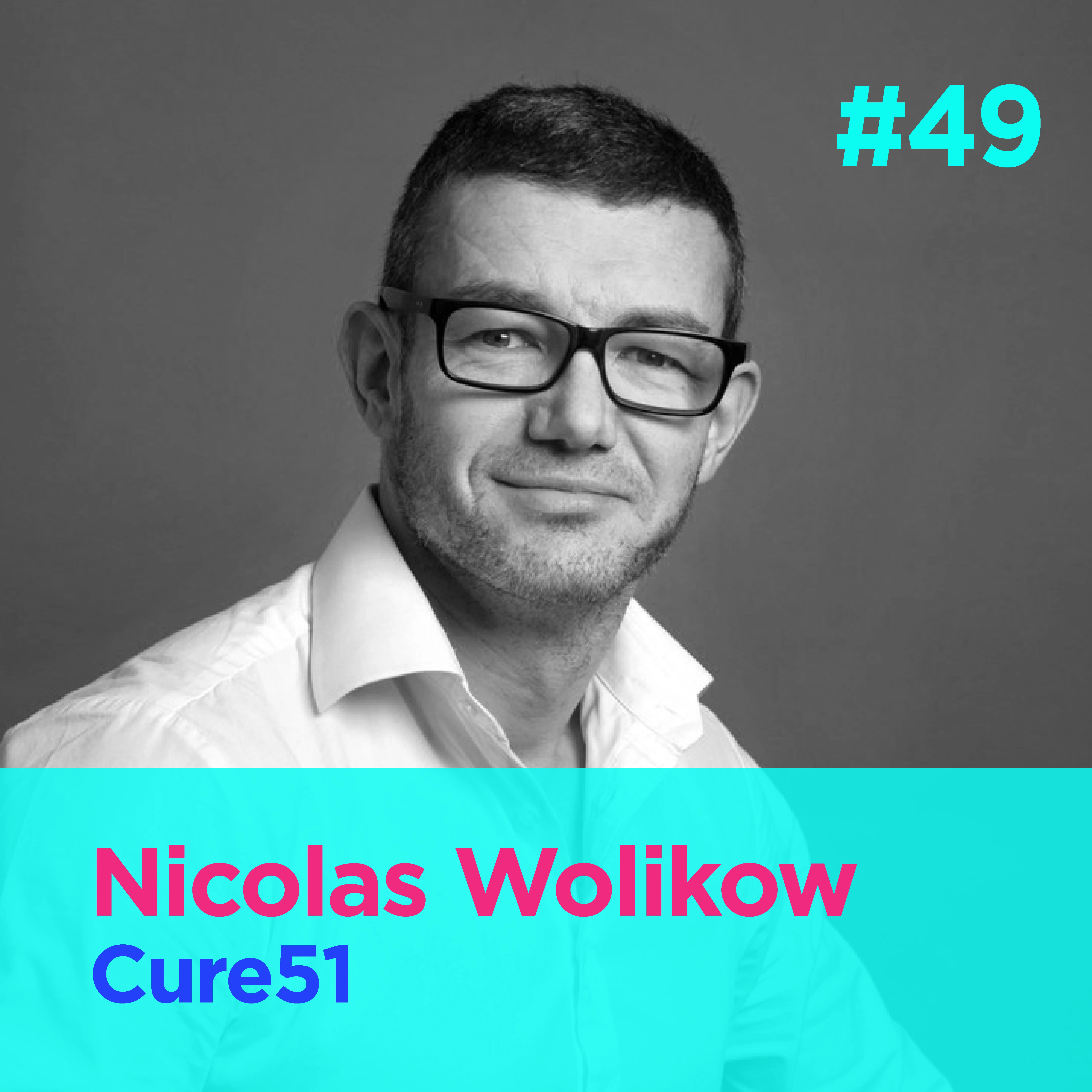
Nicolas is Co-Founder & CEO of Cure51, a TechBio firm creating a global medical database of cancer's exceptional survivors to decode their biology, and leveraging this unique data with AI to discover and develop transformative new therapies.
Episode notes
Can we learn from extreme cancer survivors to develop new treatments?
This is the bet that Nicolas Wolikow and his team at Cure51 are making.
Backed by the world's top cancer centers and specialists, they work around the clock to build the largest-ever health dataset of patients who defied the odds—people diagnosed with stage 4 cancer who were given a few months to live, yet survived more than five years.
The goal is to understand what makes their biology unique and what characterises their incredible response to the treatments they received.
A unique approach to identify new therapeutic targets and enrich our arsenal against a disease whose incidence continues to grow day by day.
In this episode, Nicolas lifts the veil on the rigorous method they follow to achieve this feat, from the collection of clinical and multi-omics data to the identification of these targets and their validation in clinical trials.
A method to reverse-engineer cancer survival, founded on the latest progress in computational biology and medical science, and whose success depends on the close collaboration between patients, hospitals, and industrial partners!
Timeline:
- 00:00:00 - Nicolas’ background as an entrepreneur at the interface of healthcare, technology, and digital innovation
- 00:06:45 - Understanding the mechanisms behind cancer thanks to exceptional survivors
- 00:10:24 - Stories of patients in full remission after a stage 4 cancer diagnosis
- 00:12:21 - Building the platform to host the largest dataset of cancer survivors ever made
- 00:14:36 - Making sense of the survivors’ data to identify underlying biological mechanisms
- 00:19:28 - Early findings and novel therapeutic targets investigated so far
- 00:28:18 - The economic model behind Cure51
- 00:30:45 - Convincing hospitals and health systems to join Cure51’s mission
What we also talked about with Nicolas:
We cited with Nicolas some of the past episodes of the series:
As Nicolas mentioned during the episode, you can learn more about Cure51’s activities on their website, and follow their latest news on LinkedIn, Instagram, and Facebook.
You can reach out to Nicolas via LinkedIn and find more details about the ROSALIND study in this abstract.
To hear Camille Moses’ incredible story as a cancer survivor, we invite you to listen to her testimonial on the Project Purple podcast.
This conversation is part of Impulse's exploration of how science, medicine, and technology are transforming cancer care. ✉️
If you want to give me feedback on the episode or suggest potential guests, contact me over LinkedIn or via email!
And if you liked the episode, please share it, subscribe to the podcast, and leave a 5-star review on streaming platforms!
You can also support my work by doing a PayPal donation @ImpulsePodcast!
Lastly, don’t forget to follow our activities on LinkedIn and our website!

Full conversation
Episode transcript
Generated from the YouTube captions and lightly cleaned for readability. Names and technical terms may contain transcription errors.
Read the full transcript
The idea is very simple. We want to understand the mechanism be behind cancer. Uh and instead of looking at people who are dying from cancer, we are looking at people who are miraculously surviving after cancer. So we are looking at a very specific population. We call them the outliers because we are focusing on patients who are diagnosed at a very late stage what we call stage four. So when the disease unfortunately is metastatic. So it's not only one organ uh it's two three four organs that are attacked by the disease when most of the time surgery is not possible and where chemo is not really efficient and uh the definition of an outlier from a
clinical standpoint is a patient diagnosed in stage four who survive more than 5 years after the diagnosis. [Music] Hello Nicholas and welcome to Impulse. It's it's great to have you here. Um I'm glad you accepted my my invitation and you know as a background for our listeners. The first time that I heard about your work was during Half Europe last year. Um not this year because I think they the conference took place like two weeks ago. I don't know if you actually went back. Um but it was in Amsterdam and you were know speaking on stage as part of a panel about what you are doing um you know studying cancer
survivors or so-called outliers as a way to you know understand better the mechanisms of survival and and resistance um in different ranges of cancers um which I found very very interesting. So um as I was thinking about you know certain topics for um the next season of the show I I remembered that panel discussion um that you were a part of and um yeah I thought I would you know reach out. Um so close to a year later um I think here we are and you know I'm all ears and and curious to understand the the important work that you guys um you and your team are doing um to see a bit you know what what we
can learn from from these special individuals and how it changes from the traditional way um let's say to to understand um cancer and doing research. Um but yeah, before we we go there, um and as I do on on every episode of the show, I would invite you first, Nicholas, to to present yourself. — Uh thank you very much for the invitation. I'm very happy to be here and uh glad that you saw me last year in Amsterdam on stage with a patient and a doctor. So my name is Nicolola. I'm the CEO and the co-founder of Cure 51. And I will detail a bit more of course what it
is all about. I'm 53 years old, so I'm an old entrepreneur. This is my fourth company. So I already tried successfully most of the time but I had as well some failure in the past to set up and run companies and this is the I think my biggest pleasure in life start fresh with brand new ideas and try to scale operations grow the community of people working with us uh and make it profitable. uh but you know getting older at some stage what you want to do I mean this is personal but that will probably resonate for other people and listeners you want to make sure that there's a good articulation between what
you want to achieve professionally and what you want to deliver as well from an ethical standpoint and that's why you know health in general and specifically oncology is a playground that I like even if sometimes you know cancer is tragic When you can contribute in a way to improve the daily life of patients or even better find new treatments, new drugs that can heal cancer, cure cancer and maybe eradicate cancer, you have a lot of satisfaction. From a business standpoint, you you think you are building an asset that is valuable. And from a personal standpoint, you have the feeling that you have an impact on a on an issue which is unfortunately
tragic and uh with a growing incident in every country. Cancer unfortunately is growing everywhere and uh impacting all the segments of population. It's not only a disease that would impact all people unfortunately the you know the emergence of cancer in younger generation is a global phenomenon in in Europe in the US but in emerging countries as well. So at some stage you know I thought to myself I have to tackle this and this is really what I'm here today. — So I saw you know when I was preparing the episode that you worked in very different environments and industries before you know stepping into healthcare. So I I I saw that you worked
on the French Ministry of Foreign Affairs in the real in T online daily motion um you know many different areas and so I was wondering you know what um how did you go into you know medical technology and the the field where you are now — originally uh because a company was desperately looking for a manager in Russia an LTE company and uh for many
reason I speak Russian fluently so But they just knock on my door and offer me the job. But I was not proactively looking for a job in in else. Uh my background at the time was essentially tech. Uh so I I I work in many different tech industry but I was very much techdriven and uh what I was looking for was always something global with international exposure and capacity to work in a multinational environment. So this opportunity came. I was just got married at the time. My wife and I were very tempted to expatriate ourselves. So when the opportunity come to go to Moscow, it was 17 years ago. Uh we said
yes and and I went to Moscow. And since then, so 17 years for for the last 17 years, sorry. Uh I've I've always worked uh in the else industry, but it was originally not something that I was thinking of. — So pure pure hazard. So um what is the idea behind you know cure 51 um where does the idea come from and you know what what are you guys trying to to achieve? The idea is very simple. We want to understand the mechanism be behind cancer. Uh and instead of looking at people who are dying from cancer we are looking at people who are miraculously surviving after cancer. So we are looking at a very specific
population. We call them the outliers because we are focusing on patients who are diagnosed at a very late stage what we call stage four. So when the disease unfortunately is metastatic. So it's not only one organ uh it's two three four organs that are attacked by the disease when most of the time surgery is not possible and where chemo is not really efficient. And uh the definition of an outlier from a clinical standpoint is a patient diagnosed in stage 4 who survive more than 5 years after the diagnosis. Uh we are talking about one or 2% of the
patients. So unfortunately when you are diagnosed with a stage four cancer most of the time your life expectancy is 6 months 9 months maximum one year. And the oncologist will tell you, "Dear Nicola, talk to your family. Make sure that you can organize the the rest of of your life and and enjoy your last moment." And still there are these miraculous patients, these outlier who are surviving. So our job is to identify them very hard because it's a very rare population. In order to identify them, we set up a network of hospitals. There are more than 100 hospitals now in our network in 31 countries and once we identify those outlier we
are collecting all their data. So it means clinical data. We have the medical file. We're going to know the lines of treatment the surgeries the allergies the anticestence all the drugs that they will have. We're going to collect imagery all all your MRI or CT scan etc. And most importantly, we collect the tissues, the tumors, the human tissues that we are importing from 31 countries in the world. We biiobank those tissue into our lab in Paris. And then we're going to do what we call multiomic analysis. So we're going to look at every layer of the tumor cell, every layer of the genome to understand what are the biological mechanism that
explain this incredible survival. Once we decode these mechanism, what we want to do of course is to develop novel therapeutics, new drugs based on this exceptional biology. So this is cure 51. — So which cancer types are you guys uh focusing on at first? Because I think cancer is like a general term and there are many many different types of of cancer. — We dec Yeah, good question. We decided to tackle the most aggressive cancers, the most aggressive indications. So which are pedock pancreatic pancreatic cancer sorry glyobblastoma so the brain cancer and the small cell lung cancer the most aggressive form of the lung cancer. So these are the three
indications we are focusing on for now — and as you mentioned uh you know the description of what you call the the survivors or the the outliers. So you said it's people who got diagnosed at stage four and who survived longer than 5 years. Um are there like um my question was among that cohort of patients are some kind of like cured or survive like fully and in remission or is it just a matter of like delaying the — No no no no you have you have patients with full remissions uh full remissions uh I can give you two examples totally opposite if we are focusing on the pancreatic cohort I know one patient he
had only three cheo and after that total relapse total remission. Another one younger actually when he was diagnosed in stage four he was 36 so very young 134 kinos he is surviving it's it was eight years ago uh in both cases uh pancreatic cancer with metastasis in kidney so very aggressive form of evolution and both of these patients are surviving even though they had a totally different experience three versus 132 But they are fully recovered. They do sport. They enjoy their life. They have a professional activity. — So — incredible. So types of of typologies. Yes. — So really the criteria is like you know diagnosis stage four and more at least
five years of survival and then you accept — which is which is exceptional. Yes. And it's a retrospective study. So sometimes you know we we got tissues that are 12 15 20 years old. So some patients unfortunately uh died but not necessarily from cancer you know just we are retrospective so we are dealing with a population sometimes which is uh very old. — Yeah. Yeah. And so you mentioned you know the all the diversity of of data and information that you guys are collecting which I think is quite unique. um what is your approach to you know kind of like collecting all these data points and all these samples because you said you were you know
active in 31 countries like um I think it was 100 um you know hospitals that you are working with so how do you orchestrate all all that network — very good question and in addition to the diversity of the data we have a huge ethnic and geographic diversity you know unless most of the clinical trials we are not only dealing with western European or American patients We have patients in Latin America, in Africa, in Asia. So to deal with uh this heterogenity, you need two things. Ideally, you need one unique platform to collect the data. So irrespective of the origin of the data, you're going to collect the data following the same
protocol using the same tools and c curating the data the same way. So we decided to have our own platform, our own proprietary platform that we developed from scratch as opposed to buying a software of the shop due to the fact that we have this unique platform. We are sure that the data is collected the same way you know with the same data point. And the other thing is that it's a clinical study. It's a non-interventional clinical study, a retrospective one, but we just have one medical protocol for the entire network. So even if you deal with a very modern American hospital or with an hospital uh which is I don't know in Pakistan or in
Uruguay you are using the same protocol. So the inclusion criteria are exactly the same. The QA process is exactly the same and all the controls that are made locally and and here as well at at the HQ of the company medical control and clinical control are the same. So by having the same methodology, the same medical protocol and the same tools, you make sure that your database is homogeneous and that you can compare one data to another. — Makes sense. Um my next question would be around you know how how do you guys um approach making sense of you know all that information because it's a diversity of modalities you know in
terms of like you mentioned b like biopsies or like physical samples you mentioned information from electronic health records — um additional you know I guess lab test clinical clinical tests so there's like a very big diversity of of information types so I was wondering there if you can tell us a bit more about how you guys are you know approaching it to to make sense of all that information. — It's a very good question. First in the database for one survivor you have what we call a control. So it's a patient from the same cohort ideally the same hospital and of course from the same disease the same indication who died
unfortunately at the medium of the life expectancy. So most of the time after 6 months uh after diagnosis and for one outlier for one survivor we have one control. So every outlier is matched is paired with one control. By doing so to answer your question what we're going to do is to compare those two patients and isolate what is very specific to the outlier and that you don't have with the control arm. Um this is the first thing that we are doing. So by doing so you're going to you're going to really enhance the differences and the specificities of the outlier in terms of biology. And then you're right we already find a lot
of signals. So the question is are we going to find some signals some patterns some signatures very specific to our clouds? Yes. Too many. The question is how do you make the ranking? So to make the ranking to decide what is prevalent, what is of interest, what is significant from a scientific standpoint you do many things. First you look at the public literature. Some targets that we are finding have already been studied either in academia or in some early stage clinical trials for instance. So it's a first it's a first marker. Then you see oh there's an interest there's already scientists around the world working on that. So we probably have to keep it and
work on it. And then when you are dealing with pure novelty and we are finding some new things, new patterns, new targets uh that don't have any equivalent in public literature. Uh then you're going to kind of stress test them. So you're going to do a lot of test including experimental test that we are doing now for instance on organoids and you're going to ideally make sure that what you are finding in silicico by analyzing all these data can be tested as well in vivo. Uh so another way to s
refine and and make your ranking more sophisticated. And then the last thing we're going to do is developing our own lab. So what we call a lab in the loop. It's a lab which is mostly driven by AI where you're going to mix in silico and in vivo and it's a 247 lab you know I mean working all time and you're going to permanently test the robustness of those signature and those targets uh lot of perturbation to finally get you know the the best of it. So the five or 10 targets that have no equivalent and that have probably a big therapeutic impact and then ultimately but we are not there
yet you go through you know the typical uh clinic pre-clinical step one step two step three but the big difference with the usual methodology is that a we already know the outcome we know that those patients survived so we know for sure that they have something exceptional um and B we think we can go faster by
you know mixing an experimental work on a big organoid platform together with AI world or machine learning okay and the last thing is that we benefit from an incredible network not only of hospitals but of Kwell of scientists we are working with you know the best oncologist in the world so each time we isolate something we think it's worst of interest we're going to share it is a community and tell them this target in global blastorm these are the characteristic what do you think guys should we continue should we de prioritize so it's really a mix between AI and and machine learning and algorithm but of course as well we
capitalize a lot on the knowledge and the expertise of our of our physicians all over the world — understood and so going back to the the control arm and the you know the control individual for each um survivor ever in the cohort. Um they are also matched in terms of the treatments they they obtain. Right. — Yeah. Yeah. The lines of treatment they have. Absolutely. It's part of the criteria. Yeah. Exactly. Exactly. So we going to match together for instance in if you got fulfaced.
Um what are some of the you know early signals I would say from from your research like any are there already like certain findings um you can share at this stage? Um — there are some early stage finding especially on the PIDA core because this is the one that we prioritized. So this is where we put maximum effort in terms of science and bioinformatician team efforts. So we find already uh just after three months you know we started the sequencing not the collection but the sequencing just three months ago we already find two targets novel targets uh which have been already validated experimentally. So what we did in 3 months sometimes you
know takes four five 10 years in the traditional industry. So it's very encouraging again it's very premature. Uh there's plenty of things to do to validate those assumptions, but it's very encouraging. — And have there been like any surprising, let's say, yeah, biological or genetic findings from from from the cohorts so far like something that you know maybe one individual — we need to have a new conversation in six months or one year. But uh now what we find sometimes uh and if I if I if I keep talking about the pedak um cohort we find some um expression of genes that are usually associated to other disease I mean other
indications like colorctal for instance and we find them as well in the court of the pedak survivors. So maybe there's as
probably kind of a repurposing things behind it and uh the overexpression of a gene which is traditionally not associated to pedak but to something else in the pa court might explain partially the survival. Uh so it's very interesting for the for the the next step of the of the analysis. We might have you know some um some crossroads at the intersection of different cohorts. So maybe the clue to the survival of I don't know small cell and cancer patients will will be found in in glyopblastoma or in ovarian or in stomach. So it's the the interactions uh
between the tumor cells and its micro environment is not necessarily always attached to one specific disease. So we can have some pen cancer uh explanations. So it's very interesting as well. This is something we are looking at. when when I was you know thinking a bit about your your approach I mean I had the the following question that came to my mind. So I was thinking like what what is the level of evidence that we have you know that kind of like indicates that what we would learn from the biology of these survivors can be kind of like replicated or applied to you know other patients who might not have those properties because I'm
thinking like if it's a certain you know genetic expression profile or if it's other aspects of what this what makes this person unique how can we you know translate this into It's a very good question and I'm not sure I have Yeah. It's a very good question and I'm not sure I have all the answers. There's something I must say that I forgot to mention in the introduction. I'm not a PhD. I'm not a doctor. I'm not an oncologist. So I'm surrounded by expert much better than me in those matters. So I'm going to give you first answer but at some stage I have to stop because I'm not legitimate and I don't have the
skills. Um no but what we you were asking me what did you find so far? What we are finding so far and and again this is really the beginning of the journey uh is that most of the things that we are finding are exceptional response to treatment. Okay. So this is something that those outliers have in terms of gene expression that makes the treatment extremely efficient. Remember this patient after three kio was fully fully um — yeah recovered — cured. So this is what we are finding so far as opposed to immune system or exceptional biology. Maybe if we have another conversation in three months I will tell you something else. But so far
this is what we can find. So if this is one of the clue then it's easier to adapt it to the rest of the patient. You just have just have to develop a drugs with the to that will overactivate that gene. Um but again very premature very premature — yeah understood so we'll need to have like another maybe another — and that's fine as well sorry yeah the only thing I can add this is what we mentioned before the fact that every outlier is paired to a control is really to make sure that we we can find commonalities with these two population we are looking at differences but we are
looking as well at commonalities it's very important we are looking at both actually — understood Um so you know you've spoken um I think in your introduction about you know in some I think in some other interviews about eradicating you know cancer from earth um which is a good mission I guess. Um I wanted to ask you you know what does success look like for you in you know maybe in the next 5 years like mid let's say midterm. So we never said in five years, we said in 15 years or in 10 yeah from 10 to 15 years. But uh as you said in your introduction, unfortunately cancer is
very complex and it's a it's a per indication disease. So I'm not sure we're going to find one clue to kill all cancers. But that's why we decided to start with the most aggressive ones. And these three cancers are not only the most aggressive ones. These are the ones where the therapeutic landscape did not evolve at all over the last 30 years. I mean pedak is a good example but this is the same for glyobblastoma. I mean it's a it's a tragedy. We don't we I mean the worldwide community the scientific community doesn't find efficient drugs for glyopblastoma. So the first satisfaction for us the first major achievement will be to find what we call
targets. So therapeutic target validated robust for each of these three indication excuse me that we can then develop uh in order to develop new drugs. And the second thing we want to go faster than the usual industry cycles on average to develop a drug till FDA approval it takes from 9 to 12 years on average sometimes 20 years. We think that due to the fact that this data set is exceptional and unique and mixing up scientific expertise together with AI, we think we can reduce those cycles by two or three. So to answer your question, I would be very proud when we would put on the market our first drugs and hopefully in
less than seven years. — Yeah, that's an ambitious goal. Um I was also thinking you know when I was um looking at at um your you know details about your study and and the the general approach um you know beyondcology do you think this you know survivor centric and datadriven model can also be applied to some other disease areas? probably uh uh probably uh of course u some neuro disease um when there's a you know a
survival population uh Parkinson might be a good example for instance whe when there is a survival population we might probably adopt the same methodology uh identifying the survivors collecting the data having a control harm and see how it looks but again I'm very cautious because as opposed to the proclars in oncology where we have a lot of articles and a lot of works that has that have been done by the academia. uh I I don't know if there's the equivalent for neuro for instance there is probably but we never work on it but
it that should be possible that should be possible and again the beauty of of these network of hospitals is that most of the time we are dealing with the oncology part of the hospital but when we are dealing with big hospitals they have as well a new unit they will have a rare disease unit as well so that once you know you have an established relationship with the hospital the data collection when you go to other therapeutic areas will go faster. Your contract are already established. Most of the rules in terms of budget, privacy, data management, transfer are done. So you can accelerate the data collection because 80% of the of the
paperworks are already done. — Yeah, it makes sense. I wanted also to understand a bit better like maybe from a it's more like a commercial or a business perspective like how you guys are set up. um how is you know the current research funded um how are you going to get you know returns on that down the line. So, two answers. First, we are privately funded. Um, totally privately funded. We made what we call a seed round. A first um a first fundraising last year for 1515 million euros as a seed fund with three investors, one in Europe, one in the US and one in Japan. So, it was important
for for us to have this international footprint from day one. And we are working now on a series A which will be much more significant in order to grow the platform uh launch new indications new cohort and develop our own lab. Uh and in terms of business model to tackle the second part of your question the business model of the company is very simple. I was talking about our capacity to isolate targets. The idea is to have a catalog, a library of targets and you can have five or 10 target per indications and in four years we're going to have 12 indications and each time you have a validated target you
choose the best partner to develop the drug. It might be a farmer or a biotech. We keep the IP because notable fact cure 51 owns 100% of the data set. So the data is our property. So we own the data set and you have a deal a traditional farmer deal with milestone and royalties uh and you get the you have a revenue sharing agreement with with the farmer. Uh but again the beauty of the model is that you can duplicate it many times for each indication. So this is the business model of cure 51 developing finding new targets that are validated and then finding the best partner to develop the
drug. Our business is not we are not a biotech we are not a pharma company we are a tech bio company we have a platform we have a network of hospitals we find patients we collect their data and we understand the mechanism uh behind the survival — very clear um how did you convince the or you mentioned IP and you mentioned that you are you know the the sole proprietary of of the data set how did this work with the the different house systems because you I we we recorded in episode I think it was episode 40 with Jean Philip there from Okin that you probably know and he was explaining us
their approach which they use like federated learning to leverage local databases and I guess they don't own the data set so — some curse to hear — um we convinced the hospital to work that way with us around I would say three pillars the first one is that we have a revenue sharing agreement with all the hospitals 10% of the future revenues of the company are shared with the hospitals depending on the number of patients they brought to the study. Second thing uh when they give us a court let's say of 10 patients I would make the full molecular sequencing of those patients and I will give them back the data. So each hospital has access to
the raw data of its court. So by doing so you contribute to the scientific effort. It's important for hospitals in France or UK or in the US. Imagine for hospital in Uruguay or Africa where they don't have access to those kind of technology. It's incredibly precious. And the third thing is that we are creating a scientific community where we make sure that any oncologist from our network can talk to his peers. We make sure that and very soon you will see it. We have co-ublications uh and we try to encourage encourage sorry and accelerate research work inside the network. So we are creating a scientific community as well with a very
renowned oncologist and I think it's a it's another factor that can explain the motivation of the hospitals and maybe the last thing is more cultural we are a startup we are not a farmer we are not a corporate and we are not backed by any farmer actually we don't have tanopi or bms in our capital and I think the fact that we are totally agnostic it's something that hospitals appreciate we are independent and agnostic and we try to go fast uh and they like it actually. — Yeah. No, thanks for sharing. I think it's it's also quite unique in I mean that model is also seems to be also quite quite unique. Um I guess you're
always open to have more cases to to the database like is there a certain number of you know um there is a yeah I mean according to the medical protocol uh this is the magic number that the scientists gave us to have enough statistic power you need uh 132 alkliers
per cohort. So it means 132 outliers and 132 control. uh we decided to increase that threshold to 170 just to have kind of a contingency. So 170 outliers 170
control but actually we don't put any uh maximum limit. So we keep collecting the data. I mean the outlier finding one outlier and have access to his data is so precious that every every time we we have access to a patient that meets the inclusion criteria we we we take it we take it into the database — for maybe for if there is know someone from from a health system or oncology unit um listening to us and you you know who would like to you know maybe I don't know submit a case or like you know be get in touch with you how How how are you kind of like recruiting or you know
um create establishing new collaborations with hub systems that are not part of the network yet? — You mean how are we on boarding new centers? — Yeah, exactly. — Yeah. Yeah. Most of the time I mean not most of the time actually all the time we are starting with uh with PIs. So we would identify in a in a in a given hospital one PIS or two PI sorry working
on the indications uh from the from our study. Then we will engage to those PIs. We will share the medical protocol. We will explain the approach and then if we think that they are motivated and they want to participate, you know, we they sign an NDA, we are sharing the dog, we negotiate a contract as we are the sponsor of the study, we would pay for all the operational uh expenditures and cost. So number of days that the PI and will dedicate to the study, the same for the CRA. Uh the same for the bio banking cost etc. We negotiate a data management transfer agreement and then we start you know collecting the data.
So most of the time we are approaching the centers sometimes centers and hospitals come spontaneously to to to us uh and most of the time through our website there's a section in the website where you can apply or when you can ask for more information. Uh, and this is how we establish the contact. — Makes sense. I'll put the the link in the show notes to the I think it's called the Rosalind study, right? — Yeah. The Rosalin study. It's a tribute to Rosalin Franklin uh the famous British oncologist. And this is why as well we are called cure 51. It's a reference to the cliche the cliche number 51 when she for the first time
identified the structure of DNA. — Interesting. Yeah. I didn't not make made the link. Okay. — Yeah. — Cool. No, it's it's very interesting. I mean I I may may I ask you like until when or according to the protocol like um until by when should the the study be finished? — Never because we're going to increase the number of indication every year. But for these three first indications, we think that we're going to end up the collection in December. So at the end of the year uh by by December we would have probably more than 700 survivors and 700
controls for these three first indications and then next year we're going to launch two indications and the year after and the year after as well. — Makes sense. Cool. No, I I'm I'm really, you know, impressed. I'm looking forward to to seeing, you know, what what what comes out of — Me too. Me too. We are all excited. you know, I I thought it was quite interesting that I mean, I'd never heard that approach of like looking into survivors to understand conditions in other disoras. Um, which in a way is a bit surprising because it would also be a logical, you know, way to to think about it. Um, but
I didn't make a search if there are like, you know, other let's say initiatives. Um, there is another initiative that inspired us a lot actually, but it's not in oncology. It's a US company called Variant, Variant.io. IO and they have the same approach. So retrospective approach but they will look at what they call the superhero. So people you know who have incredible physical capabilities. — They just sleep two hours a night or they have some blood pressure which is incredibly low. So this is the population they are looking at. Uh so it's a bit different than us but the approach is the same and uh this is a company we looked a lot with my
co-founder uh and it was an inspiration. So more on the longevity — kind of. Exactly. Exactly. Not in oncology, more in longevity. Absolutely. Yes. — Sense. Um so you know um I'm you're conscious of your time Nicholas and um I'm very thankful for you know you coming to to the show and and and taking us through your your story. Um for our listeners you know who might be interested in learning more about your work and let's say by extension um having you know being interested in the field in which you work like would you have specific resources you would like to redirect them to um could be books publications uh websites
— we did not publish yet unfortunately but we will soon uh I hope that for the next we'll be able to publish something but no but they can contact us through the website and especially if it's physician or oncologist. We can share our uh white paper. We can share the posture of the study. We can share the synopsis of the medical study. Uh the we can share the the list of the hospitals we are working with. Uh so there's a know I would appreciate any spontaneous application for people that want more information about the project. We are very transparent. It's one of our key value transparency. We're very transparent with the hospitals. We're
very transparent with the staff and we are very transparent as well with the medical community in general. — Yeah. I mean let's let's include as well the those details in the in the show then people can find them directly. — Okay. — Um could you share with us maybe it's again a bit early to ask the question but as I ask it all the time I'll I'll still do it. Um, can you share with us an addition like an anecdote from your work at cure 51 that already kind of like made you realize the the impact that you were having on on people's lives? — Uh, I can tell you the first patient we
talked to because again the beauty of this project is that yes it's a database. Yes, we are talking about a tech platform but we are exposed as well to patients every day. So it was really early stage three years ago. At the time we had nothing. We didn't have a product. We were starting you know having conversations with hospitals trying to convince hospital to work with us. Uh we were auto financing the project. It was before the sided run and I was uh you know surfing on Facebook on Instagram trying to find communities of cancer survivors and I found uh a patient in the US in Florida Kami who survived 12 years to pancreatic cancer
and I just sent a you know a direct message thinking to myself there's no chance she answers I'm not oncologist nobody knows me she answer immediately we started engaging and she's the one actually who on the signature of the company hope is for everyone cure 51 it's the tagline is hope is for everyone this is coming from Camille and since then you know she's uh she was our first ambassador she's a member of our patient committee and she's really active you know in advocating for the cause she's helping us to be more visible in the US but the fact that she trusted us from day one even though again it was only
two crazy French entrepreneurs with this crazy ID with no medical background was you know a very strong signal for us uh which is still resonating today saying she did survive. She wants to share experience. She wants to give hope to every patient who unfortunately is suffering from cancer. We need to make sure that this dream this ambition can be achieved and this is a source of motivation on a daily basis for us. — Thanks for sharing that. If you would recommend um you know a fellow healthcare innovator or you know as a potential guest for the for the show who would you recommend these people from varian.bio bio uh they already
negotiated you know first deal with the pharma industry so they were able to value their incredible superhero database they are based out of Seattle uh very nice company uh I know some people there uh one of their co-ounders with one of our advisers actually and it's a it's an incredible company they work a lot with African population in Kenya and Ethiopia in particular if I remember correctly so it's a kind of a fascinating company as well fire in.io. Okay, well noted. I I'll check them out. Nicholas, um thank you so much, um for taking us through what you guys are doing. Um I think there's probably a lot of, you know, curiosity that was created
throughout the conversation. So I'll invite also our listeners to, you know, follow um the rest of your adventure. Um I guess your present on, you know, different how can we actually get in touch and — Instagram, LinkedIn, Facebook, we present on the on the three networks. — Super. Yeah. Then I also put all the links in the in the show notes. Thank you so much. Thank you very much. Thank you. Thanks. for watching the episode. I hope you enjoyed it. You can subscribe by clicking on the podcast channel at the top right and watch another episode here at the bottom.