01.09.2025
#45
Shavini Fernando
OxiWear
Measuring oxygen with a smart earring
Listen on your favorite platform:


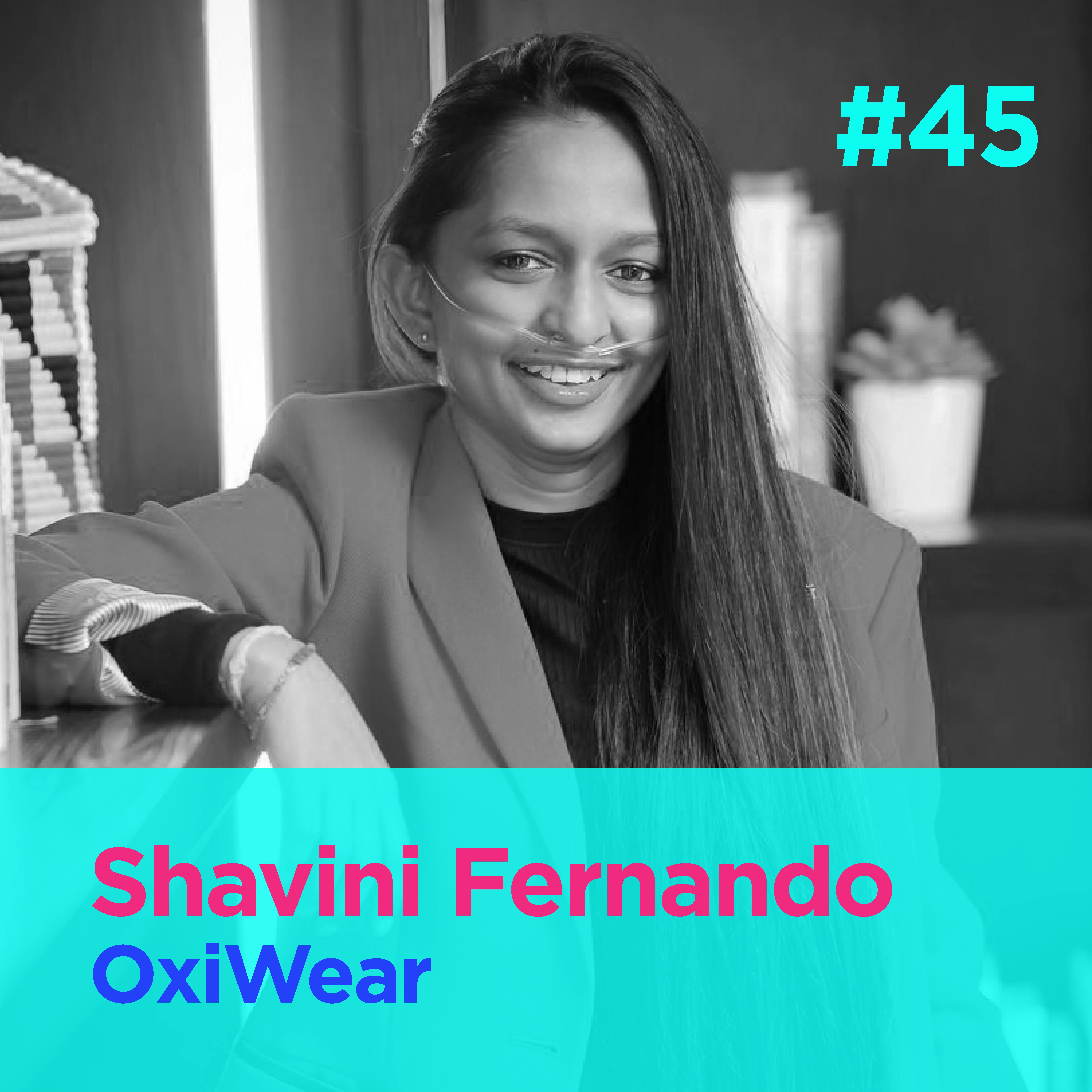
Inspired by her own health journey, Shavini is the Founder and CEO of OxiWear, a company developing a wearable device for continuous oxygen monitoring to prevent medical emergencies caused by silent hypoxia.
Episode notes
Do you have to come close to death to invent a groundbreaking medical device?
That’s certainly not something we would wish upon every medtech entrepreneur.
But it is the story of Shavini Fernando and the connected medical earring OxiWear that she developed.
Shavini lives with Eisenmenger syndrome, a condition where the two ventricles of her heart communicate.
This condition dramatically increases the pressure in her pulmonary vasculature and severely limits the oxygen carried in her blood.
It’s a critical situation that has already caused her four cardiac arrests and three strokes, all of which she has survived.
Constantly reliant on supplemental oxygen to live, she dreamed of a way to measure her oxygen levels in real time while staying active.
This would allow her to anticipate sudden variations in the future and the life-threatening risks they bring.
And she made that dream come true by creating the first connected earring, FDA-certified, capable of measuring blood oxygen saturation in real time.
All in a discreet format, lighter than an AirPod, and designed for use during everyday activities, including sports.
In many ways, this innovation has transformed her own life, as well as those of hundreds of patients who have benefited from it so far.
In this episode, we revisit her story as a patient and survivor.
Shavini opens up about the immense challenges of living with Eisenmenger syndrome and developing OxiWear, sharing her vision for this technology and the potential it holds for the future of cardiorespiratory monitoring.
A touching and sincere conversation with a truly exceptional figure in the healthtech ecosystem!
Timeline:
- 00:00:00 - Shavini’s story as a pulmonary hypertension patient surviving four cardiac arrests and three strokes
- 00:19:13 - Building the first smart earring to continuously measure oxygen levels while staying active
- 00:25:20 - The design behind OxiWear and the challenges to bring it to life
- 00:31:24 - The blessing of COVID to access funding and educate the general public about cardiorespiratory health
- 00:36:57 - Making OxiWear the ultimate cardiorespiratory device for remote patient monitoring
- 00:39:47 - The business model behind OxiWear from a medical and consumer perspective
- 00:43:10 - Overcoming the torture of creating a medical device from scratch
What we also talked about with Shavini:
- MedTech World
- Georgetown University
- Johns Hopkins University
- Leonsis Family Entrepreneurship Prize “Bark Tank” created by Ted Leonsis
- MassMEDIC
- Renal cholesteatoma
- Sickle cell anemia
- Photoplethysmography.aspx)
As we mentioned during the episode, you can watch here the recording of the panel I hosted alongside Shavini at MedTech World in 2024.
As Shavini shared in the episode, you can learn more about OxiWear at Oxiwear.com.
Although we did not explicitly talk about it, I also recommend you watch Shavini’s TEDx Talk recorded in 2019.
You can follow OxiWear’s activities on LinkedIn, Facebook, X, TikTok, and get in touch with Shavini via LinkedIn too!
This conversation is part of Impulse's exploration of how medicine, science, and technology are transforming patient care.
If you want to give me feedback on the episode or suggest potential guests, contact me over LinkedIn or via email!
And if you liked the episode, please share it, subscribe to the podcast, and leave a 5-star review on streaming platforms!
You can also support my work by doing a PayPal donation @ImpulsePodcast!
Lastly, don’t forget to follow our activities on LinkedIn and our website!
Full conversation
Episode transcript
Generated from the YouTube captions and lightly cleaned for readability. Names and technical terms may contain transcription errors.
Read the full transcript
But the devices it's only about re going back and adjusting to what the FDA wants and someday one day you will still you will get the clearance right it's not that we won't get clearance the devices it you don't know when you will get the clearance but you will get the clearance right it's just you will have to redo stuff so but still no one wants to put money there So it's a I don't know it's quite weird because there's so much money going into medicine and drugs which are like about good 40% funding but then for devices it's about 2% funding that comes. — Mhm. — So it's it's so it's very hard to find
money. [Music] Cool. So, we're on um hi Shvini and you know, welcome to the show. It's a pleasure to have you um here and you know, connect once again since we last saw each other in Malta during that tech world last year um for a panel on stage that had the chance to to moderate and where you spoke um where we talked about entrepreneurship in medical in medical technology in medtech um what it meant to be a woman these days, you know, leading a medtech business. Uh I think the recording is online so I'll add the link you know to the to the episode description if you know listeners want to check it out. Um as we
also you know preparing you know ourselves for the next season of the show. I was really keen to have you on the podcast. Um there are several reasons for it. Um I think first you have a very interesting and quite incredible you know history as a patient on the personal side. So we'll talk about that in a minute. you have a contagious, you know, energy and enthusiasm that I haven't seen in many people to be honest for having spent some time with you in Malta. Um, unless you also develop, you know, yourself what is now a medical device that, you know, you wear every day. Um, and that, you know, basically transformed to a
large extent, you know, your your quality of life. Um, so I don't want to spoil, you know, any listeners. I I won't say more. Um, I'm just very thankful for your presenting time. And to get us started, I would simply ask you to to present yourself. Hi, I'm Shavini Fernando, the founder CEO of Oxiga and literally I started this uh in 2019
because I came to US for a second opinion as I got diagnosed with ice and mango syndrome in 2015 and then I was told that I am not supposed to go home again because I can't get on a Right. And then I was studying at Georgetown because I had to get my visa sort at least the easiest was to study again. But while I was studying as a result of ice and manga syndrome, everyone who has ice and mango syndrome has severe pulmonary hypertension. So the pressure inside inside the heart and lungs not the external pressure you see with the cuff but the pressure inside the heart and lungs is really
high than normal. So mine was six times normal and they said it's not safe for me to get on a plane. So I had to start study again. So because of this pulmonary hypertension we are very hypoxic. That means our oxygen drops very low for the slightest activity that we do. And for me as someone with ice and mangus, my blood flow can reverse which is uh
called shunting in medical terms which ends up sending all deoxxygenated blood around my body. So therefore the you can get severely hypoxic because of that. And what happens is because when it drops to really low levels, either you end up with a cardiac arrest because your heart is working extra hard to try and pump oxygenated blood or you can get
a stroke because you end up with cerebral edema because fluid starts building up in your brain when your oxygen drops too low and causing you a block of oxygen to the brain path and you can end up with a stroke. So I've ended up with four cardiac arrest, three strokes and then I learned that this was mainly due to my oxygen levels dropping without a warning because since I built this over time as a athlete and damaged the lungs, my body is quite used to functioning with very low oxygen. So even at 50% oxygen I would not have any physical symptoms and then it's too late once I get a
cardiac orus stroke to do any first aid. So I learned that this is mainly happening due to my low oxygen levels. But in the market there was not a single device that could measure my oxygen while I'm actually actively walking around or doing day-to-day things. And since I was athlete, I'm still adrenaline junkie. I still love doing things I used to do before. But there is no way that I can get a alert because not a single device in the market does that. Most of the devices that continuous oxygen oxygen monitoring they only built for you to get a spot reading when you are still or continuous reading also when you are still. So, you need to
keep your hand straight, hold it straight, and press a button to get a reading. Or even at the doctor's office, if you see the devices, they're all wired, and they put it in your finger, and you need to keep it straight. The hand, if you move it a bit, it doesn't read. So there was not a single device in the market which I could wear 24/7 and measure my oxygen levels and have it letting me know ahead of time when my oxygen starts to drop. So the doctors were quite worried about
me living active lifestyle or living alone. So they were like you should not live alone. You need to move back to live with your family and stop doing all the crazy things. But I was not ready for it. You know, you don't want your disease defining your life, right? You still like I don't think anyone's disease should define their life. They should just enjoy life, right? Because none of us knows when we are going to die. So you need to live life to the fullest while you got it. So I didn't want this to limit what I was doing. So I created Doxy first to prove to my doctors that I can still live my life,
enjoy life and do the things I love so that I have a timely alert and the doctors are also not worried because if things go wrong I can send my report to my doctors and they know exactly what happened and they have a they have my vitals for that episode when it happened because even when we go to a ER and when we explain no one understands what we are saying or believes us because we don't have data to support what we are saying right and so this I
built it first as a solution for myself but then after I made it all my doctors at John Hawings were like you need to commercialize this like literally all my patients need this so that's how oxifest started so in 2019 then I got a grant from Ted Leonses to start the company and I was like oh now everyone gave me money I have to really do this. So since 2019, I've been doing this full time and finally were cleared as FDA device and we actually shipping devices in the medical market um within like another two weeks.
— That's really cool. And you know I think I mean there are different things you mentioned in the in your introduction. So you mentioned you know four cardiac arrests, three strokes um if I understood correctly. Um I was wondering you know what is the cause of the like you you did not know you had this right so you only realized after a certain time in your life when you had the first event. So like when I was a small like I was diagn I had breathing issues but it was all diagnosed as asthma and like literally for my whole life I've been ne nebulizing like it was I was known as I had severe asthma because
the only sign you have for a hole in the heart is just it's hard to breathe. So I've had a hole in the heart from birth. But the thing is when I was small they have done the test but it was not visible. So the doctors have said there's no signs so nothing to worry. And then when I was having breathing issues no one literally did another test to see if that hole is there but they all diagnose it as asthma. So that's one of the reasons why I was swimming because swimming was the best solution to get your lung function improved when you have asthma, right? And so I could only do like short
distance like sprinting and swimming both because anything more than 100 m I feel it in my heart. I go breathless. So
then in 2015 like like after I left school and I was in Australia and all I was having more breathing issues and I literally thought it was because now I'm not working out as much as I did and I have poor cardio because I'm not training like I used to do in college. So and then even the doctors were like Oh, you need to work out more, swim more like and they were changing my inhaler. But then towards like 2014, 15 I started
turning blue and for that I went to a doctor and I said like something's got to be wrong with my heart because I'm turning blue and then only they diagnosed it. So what they said was like literally if I knew my oxygen level still falling before 7 years back like that means around 2008
then they could have diagnosed me early and they could have then they have science to show that something's wrong and they would have done invasive test and diagnosed and closed the hole in my heart. But now because it was not closed, there's no wall between my two atriums. So I literally have three chambers in my heart instead of four. So therefore my blood keeps flowing back to the lungs again and like
so literally when the oxygenated blood comes to the heart again there's chance of it flowing back. So that because of that when I go into a cardiac cora or something like they need to defibrillate me twice for my heart to get to the right rhythm because the first defibrillation can shunt me like reverse the flow and then the seven second one will only put it back on the normal route. So it's very tricky but for me I
thought they were cardiac I thought they were asthma attacks right. So I had all these cardiacis before I got diagnosed as well but the only sign of a cardiac aris is you choke you can't breathe — right you just entirely go choking so I've literally trained myself because of that now when I'm choking like literally how to revive my heart again so for me now it's like six tense so I don't panic and I literally know to cough from my abdomen and hit my chest and get my heart to start again. So that's it's good in one way because you know you only have 3 minutes before — you die and pass out.
— But I know to do my first aid until 911 comes. But the tricky part is because when the 911 comes, by the time they come, I'm all normal, right? And there's no signs of me having a cardiac arrest and I have no data to show them I had a cardiac arrest. So when I go to here, no one believes me
other than my doctors at John Hoffings, no one else believes me. So it's tricky, but if you know your
oxygen levels are falling ahead of time, you can actually prevent it. All you have to do is just rest and wear your oxygen and crank it up. And just don't use your legs. As long as you don't lose your legs and sit down, you can and take big breaths and oxygen, you can like get it prevent
from a cardiac. — Mhm. And this syndrome size and mangar syndrome that you that you have, how many people have that? — It's very rare. condition. — It's very rare, but pulmonary hypertension is very common. — Okay. So pulmonary hypertential literally is like due to underlying disease your lungs adjust. So everyone's lungs are literally the lungs are the softest tissue you have in the body. It's built in such a way so that it can oxygenate your the blood easily because
the tissue is lesser thick and so the blood flows through the tissues and the oxygenate they happen faster. But the thing is due to some underlying condition but for me is because it was getting too much blood. The lungs were getting too much blood than it was supposed to get. The lung tissues get thicker, right? Because it's only built to pump only a limited amount of blood. But when it gets too much blood coming, it needs to work harder to pump. So it gets thicker and thicker. So this can happen because for me it's because of that. for other people maybe because of eczema or some tissue related thing that literally
gets your lung tissues to get thicker or maybe it can be for COPD because of smoking your nicotine goes and tries in your lung walls or for cystic fibrosis or pulmonary fibroidis it's because of a fibroidis or maybe because of clem and stuff. So then what happens is then your arteries become very thin or your lung walls are too thick and the pressure that the blood comes from your lungs to the heart is quite high. So for a normal person it has to be less than 20 but for whoever has pulmonary hypertension it anything above 20 is considered hypertension in the pulmonary. So for me it's 138. I'm six times.
— Yeah. I'm six times the normal pressure it's supposed to be. So yeah. So pary hypertension is very common. So it's not. — So — and so we can see you know on the if you know people have watched the video of the recording like they see that you don't have any right now you don't have any support. um how I mean how do you
deal with it like on a daily basis because when we were you know in Malta you still had you know this um this sort of unit you carry with you just in case but you don't wear it all the time which is also like good news for you. I used to wear it all the time because when I got diagnosed until I had got my own oxyear, I was on oxygen 24/7. I had to wear it because I didn't know when my oxygen levels are falling. And after I started get wearing my oxygen only we learned like what my normal oxygen levels look like on a day-to-day activities. So then I was able to
get out of my oxygen 24/7 use and now I just carry it around everywhere with me in case if it drops for emergency because then if it drops the first thing you have to do is quickly wear it and crank it up to a higher liter. So until you revive your heart, you have your oxygen flowing into the brain and because even if you get edema in the brain like fluid in the brain, just as you start pushing oxygen, the fluid disperses so you the stroke symptoms go off. So because of that I carry it around still with me for emergency but I don't use it now as how I used to use it 24/7
before. And so now you can still go, you know, swimming, doing physical activity. — No, I'm not allowed in the pool yet. — Not allowed yet. — Yeah. It's like, you know, telling her that's the most difficult part, you know, when you are a swimmer and when you're not allowed to go into the pool. — Mhm. — So I can just put dip my legs and w but not allowed to swim because it's too much strain on the heart. — Yeah. Yeah. Okay. No, thanks a lot for
— sharing that with us. Um, so I think no people might have noticed that yeah, you have something around your ear. — Yeah, that's the octave. — That's what I wanted to talk about. So can you explain us, you know, what type of wearable it is um what it is capable of measuring and also why it's positioned on on the ear. — Yeah. So this is Oxya which is literally like the same old standard pulse oxyter that anyone would know when they go to a hospital that they put it on the finger on you. — Yeah. They put it on the finger and tell you to keep the hand still and then on
the monitor they check what your oxygen and heart rate looks like. So it's the same technology but the difference is everything that comes on the hand the wrist they all measure your oxygen only when the hand is still and when the hand moves around uh you can't literally take readings because the pulse oxyter the red light signal keeps changing. So an active person and a moving person none of the devices are able to get a continuous reading but
with oxy like even when you are active walking around we are able to get continuous readings because unlike the hand even though you move the ear doesn't move because of that it's we can continuously get the readings from your ear and for medical grade oxygen readings things the it has to be very vascularized and have lot of blood capillaries and blood flowing through your fingers and uh sorry your wherever you measure oxygen. So standard medical readings can only be taken either from your fingertip or the helix of the ear or from your forehead. And for the forehead one they really tighten it up so the light has can go through the skull to the brain.
— Okay. But on the ear, ear is very vascularized. That's why when you have alcohol, the first place to brush is your ear tape. When you're angry, when you're embarrassed, you will feel your ears be heating up. That's because your blood goes you have a you have a lot of blood flowing through your the tip of the the top part the helix of the ear. So because of that and the tissue is very thin. So it makes it very easy to get a good reading from the helix. So even if you are in a hospital ICU bed when your fingers don't work, they use the ear to get readings because and the thing is especially when
your oxygen levels hit anything below 80 like when your oxygen flow is really low your fingertips actually don't get enough blood circulating. That's why your finger sprays right? So your fingertips don't any extremities in the body don't get enough blood because your heart always prioritizes the brain and try to pump as much as brain uh blood to the brain as possible. So use are awake and conscious
and but because of that the ear you can still get a good reading unlike the fingers and so that's why like
uh it's easy for us to get readings and the other thing is for pulse oximters it's a big issue is the skin the palm
skin if you're wearing nail polish the thick nail fingernails and also So for anyone who has dark skin, the skin is on
the palm is much thicker and the pigments absorb the light. So there's a lot of things when it comes to the PPG system that you use the pulse oximters that you need to keep in mind to make it accurate for every skin tone. Everyone who has different palm skins the finger thing and at the same time for people who have diseases like renodes color sickle cell they don't get good readings on the finger at all. They can't get any readings. But with the ear, the skin is thinner and it's easy for you to calibrate it or get good readings for all skin tones and different conditions. And even people who have diseases like
scoladerma, renodes, the cursel, they still can get a reading on the ear. So therefore it helps a larger population of patients who have chronic diseases that prevents them from getting a blood oxygen reading to get a good reading and monitor them while they're doing their day-to-day activities as well. — Yeah. Yeah. And I guess it also serves that you know that purpose of using it when you're t because then you don't have anything or like I mean for example I have like an aura ring. I never use it when I — Yeah. because then — and also another thing is like I'm a developer so for someone like me who's
always using hands for work. You can't wear something on the hand all the time. — Yeah. Yeah. For sure. And the reason why you like you wear it on the cusp and not on the loop is that because on the on the lobe you don't have — Yeah. you don't have as much as blood coming like if you see now see my helix my top of the ear is red but my bottom of the ear is white and that's why we pierce the ear at the bottom because it's not that it doesn't bleed as much as you know when you pierce the top of the ear — and the working principle is you
mentioned it's poly — it's yeah it's PTG it's polythosmography — and so So it's pretty much like the sensor. It's like light sensors and infrared sensors. So they go through the blood and calculate how much of blood is oxygenated and how much of the blood is deoxxygenated. And at the same time based on the PPG you can get multiple other different readings about your pulse, your heart rhythms and different other uh signs from your body that that the doctors needs to know. And what have been like some of the technical like the biggest technical challenges you had in developing the technology like was it the miniaturaturization where you had to
fit this in a I mean we see it is relatively small. — Yeah. — So yeah that was one of the biggest challenges because our IP and my initial planning was for this to be IoT but there's no sensors that fit this size. So because of that as initial version we have to go out as a device that
depends on the phone so that it transfers the data through the phone rather than directly to the cloud and directly able to get a call. So now what it does is like it it's a
standalone device. still saves data but then it has to transmit to the phone first through the Oxyg app to go into the cloud and sending to someone. So
yeah and then getting it to this size was super challenging because our board itself is less than a 1 cm radius.
So trying to get that reading done like properly and packaging it and putting everything into that bundling it into this form factor is very hard and this is like the seventh iteration of the device because we had to change keep changing the design based on the user feedback we got because we had to figure out okay people wear headphones how does it work with headphones some have hearing aids how does it work with hearing hands And even some earphones have the back piece going behind the ear. — Yeah. — And people wear glasses and I wear oxygen, — right? So keeping all those tiny tiny details in mind, have to figure out like
how do we make a device that works with everything that people wear on their ear around the ear and you know on top of the ear. So yeah, it took us a long time to do it, but we had a really good customer base who's actually using it like people, patients and athletes who were willing to like test the device and give us feedback and even doctors because they all needed one. So
they were very we were very handson in developing like with like patients and any customer who would be using it to make sure that we make a device that meets the customer requirements. But it took a lot of time and plus on top of that it's finding money. — Yeah. — Because it's hardware unlike software you can't just debug. If you find something, you need to redo everything and change everything. And it all needs money. And the biggest challenge is investors don't invest in hardware. People don't like to invest in hardware. And on top of that when the hardware has to go through FDA no one wants to invest because it's a
risk for most of the investors because they don't know whether you will get FDA cleared or not. So people don't want to invest in like FDA or any regulated hardware. Everyone loves investing in software — but the thing is I always say it's funny everyone wants to stay healthy everyone wants innovation coming when it comes to their health they want everything but no one wants to put money for devices which actually can give you because in medical industry a software platform can't do anything it has to be a device right and It's it's funny like there are people who literally put millions of money for medicine and drug trials which may not see the end of the tunnel
at all. — Right. Yeah, for a larger part. But the devices, it's only about re going back and adjusting to what the FDA wants. And someday, one day, you will still you will get the clearance, right? It's not that we won't get clearance. The devices it you don't know when you will get the clearance, but you will get the clearance, right? It's just you will have to redo stuff. So, but still no one wants to put money there. So, it's a I don't know. It's quite weird because there's so much money going into medicine and drugs which are like about good 40% funding but then for devices it's about 2%
funding that comes. — Mhm. — So, it's it's so it's very hard to find money. — Yeah. to to to fund this type of medical devices. — Yeah, it's it's interesting because you know in what I was thinking was — we hear a lot as well about you know longevity these days. Yeah. You know
some part of the population is really into like you know optimizing your your health and I guess it's very trendy in the US California in particular. — Um and I was wondering like I mean to me this sounds also like — yeah this is very applicable for longevity. Yeah. Exactly. Exactly. Even if you don't have you know pulmonary action if you just want to know very precisely medical grade level your oxygen saturation that's just when you do sports basically throughout your day and night as well. — Exactly. Yeah. — That can be used right — because knowing that if you have any symptoms while sleeping because at the end of the day
it's literally your oxygen that keeps you alive. You didn't need to have a condition right for anyone. The moment your oxygen drops down that's the end of life. Right. Which is — pretty much — like pretty much all your organs fail because they don't get enough oxygen. Right. So it's but it was funny until co
there was zero education on it. No one understood why oxygen mind like measurements are much important than your knowing your heart rate. Right? Because the reason why your heart fluctuates is because your oxygen is low, right? Because your heart is trying to pump harder for you so to make you more oxygenated. But people just didn't
understand it until co like literally I I have to pitch to 357 investors for my first round of funding and before co no one invested. They were like there everyone thought that you had
to be wearing oxygen in order for you to know your oxygen. So because I was wearing oxygen, they thought it's only for people who like me who wears oxygen. So it came to a point where I had to remove my oxygen to pitch because otherwise they judge me by the book, you know, they judge you by the cover. — Yeah. — So and then even after co
they were still asking like while the Apple Watch can't do it. I'm like no Apple Watch can't do medical grade. They can do it. They are doing it. But it's not medical grade, right? It's not Everyone can do oxygen when it's above 95. — But the moment it drops below 90, — the accuracy is very bad, right? And that's the numbers you want to know because the accuracy goes really down. And most of them these are not actually tested for clinical trials right but still the investors and the normal users don't understand it because they don't know why a pulse oximter is needed. — Yeah. And like literally during COVID so
many was calling and asking are you are these devices available for sale for us to give to every household to track pocket like co I was like I wish I had money. — I wish we had all of — I like I wish people believe me before co. — Yeah. Yeah. But then that the good thing was that there was then a big change of — Yeah. So for me I always say the co was pretty much like a blessing in disguise for us. It actually opened up
like it educated the population of why it's needed. — Yeah. — Because people don't understand the value of breathing on until they can't breathe. — Yeah. That's true. until breathing become becomes your biggest problem they don't understand the value of it.
— Yeah, you know I was wondering the so I suppose the the current version of the device that you wear um it measures oxygen saturation it measures I guess as well you know heart rate. — Yeah. — Do you think there would be also like some other potential biomarkers you could measure with it? — Yeah. So now on the wellness side of the device uh on the paid subscription we already push heart rate variability, blood oxygen variability uh recovery rate all those but they will be pushed to the medical side as well after we do clinical trials. But on top of that we will be pushing like respiratory rate and lot of other vitals
more on the like literally on the cardiovascular side. Right? Because what I where I want to see Oxia one day is as like one respiratory device where the doctors can see every respiratory related — readings markers from one place so that they it can rather than connecting multiple other wires and devices into a patient so that they can see everything in one place in one trend line to see
and understand what exactly went wrong. — Yeah, understood. Because I saw I mean I have the impression I see quite often or there seems to be also a push now to use PPG or let's similar um you know let's say optical based methods for blood pressure. — Yeah. — But I don't know if that's something that — that's something as well. — Yeah. That would be cool because then yeah, you have one device that you can Yeah, you just wear the whole I mean you we have one as well because funny story like my my partner like won one of your devices when we when we were in the med
world so we both tried it. Um, and yeah, I mean, you don't feel it, you know, it's just like I was expecting that you would feel, you know, a bit pinched and over time you want to take it away. Like, like for example, my my headset right now, it's like kind of pressing head. — I wouldn't wear it like 24/7. Um, but in your case, it's like you don't feel the weight of it. You don't feel the pressure of it. It's — it's quite quite impressive. — Yeah. We had to wait for FDA. It's lighter than a AirPod. — Yeah. Because see I'm the guinea pig like when when a patient makes something
for them for themselves they make sure that every tiny detail matters right because no patient wants to be notifi like you know noticed by others as someone with a disease. — Yeah. — Right. So they but the devices currently in the market for anything medical they they all look very medical — right so that's something that my engineers were quite mad with me about it because when they were doing designs I'm like nope I can't wear this and because things I said was look it has to be something that I can wear 24/7 without paper coming and asking me what is this what's wrong with you
right I said it's not about my disease and not being like ashamed of what I have but it's about the inconvenience of explaining this 24 hours a day for everyone who comes and questions me — right because you have to go into detail to explain when people come and nurse and it's it's not quite
it's not pleasant when you have to do it all the time the whole day right — and you get sick and tired of it and now even when people ask me I said oh I have a busted engine that's it — short the short — yeah and so that's something Yeah so
that's something I keep in mind even now we're working on the next generation device even for that that's something I always say it has to be something that users forget that they are wearing with something you can go shower with something you can sleep with something you can you know without issue go do your dayto-day stuff because my whole purpose of doing this device was to build and bring that confidence to anyone with a chronic disease and empower them to go and live their life to the fullest. So the look and the feel of the device,
it all matters then. — Yeah. And it needs to match that expectation that you have. — Yeah. — No, that's impressive. Um I wanted to ask you regarding the the because we talked about funding and money a bit before. Um what are the business models that you follow actually to to commercialize the device? So on the wellness side, we sell the device for the wellness market through the website directly. So we are cleared as a wellness device literally all parts of the world. So we have been shipping devices to US, New Zealand, like literally all parts of the world and that website is separated as oxyear. But then nowhere.com is entirely medical
which is for the FDA cleared medical device and that we do it for hospitals as a hardware as a service. So we like we literally have a hardware as a service for hospitals at,900 for a year where they get the device the software like the app unlimited data and on top of that a web- based platform where they can pull all the data and so they can create their own reportings to the way they wanted to uh report. Right? So we have reports built for 6-minute walk test for the pulmonary function labs. — Yeah. — And then we are working with fleet departments to create reports for them. Likewise, so it's a web- based platform
where they can do their own reporting templates and we can help them to build this so that they can build pull all the data to one place and report uh for the medical requirements. So that we do as a hardware service because then if they lose the device or if anything happens because it's similar to the hearing aid it's too small and we don't have a tracking in it because there's no tracking that can go into this size. — Yeah. — So in case if they lose the device or if you know by mistake they drop it on the floor and drop something big on that and break it. Right. So they can get a they
can get one device replacement for that one year time so that we prevent the uh problem of not being having device and then also when we upgrade to the new device then they can have without having to buy a new device they can we can replace them with the new medical release like the next generation device. So we do it as a hardware as a service to hospitals so that we can reduce that extra expenses that they can have but also use this to prevent readmissions run the pulmonary function testing. — Yeah. — And different use cases that they need oxygen maintenance. — Okay. Very clear. Um you know you
mentioned so you explain your story which is you know quite impressive. I repeat you know four cardiac arrest and three strokes. Uh and then you created your own device and now you wear it every day and I think there's you know hundreds of people who benefit from it. Um you also talked about the next generation of the device and your vision you know for it having it as a one kind of like wearable for everything called your pulmonary basically. um what you know what fuels your energy and enthusiasm like what keeps you going because I mean before we hit record you were telling me about like you know supply issues of the medical device part
of the of the wearable which is you know quite a struggle um so you know it can appear like you know it is I think in a way like very successful but I think on the other side you also there's also a ton of challenges so — yeah I thought I'd get your thoughts on that — yeah doing a medical device I very openly say this is absolute torture. It's not like doing a normal one. It's so much if from paperwork and regulatory work you have to do. It's such a like there were days that we all were asking what are we doing? Why are we doing this? Right. — Yeah. And especially when investors
don't put money where your bank balance goes to zero and you're like how am I going to pay my team this week. So it's
very hard but the only thing that kept us going was the emails that we get from patients saying how this you know until we got the FDA device they purchased out the wellness device for their use and they were like how they were able to do things that they were not able to do before right even for me
after 9 years I went home last December Right. So I I I thought I will never get go home again. I will never get to go home. But after 9 years because I can measure my oxygen throughout the whole flight and adjust my oxygen flow in flight. I my doctors were fine with me going home. Right. So after 9 years I went home and
now I'm allowed to cross the Atlantic. I travel which I was not able to do before right I my first flight was to Malta right that's how we met that was my first flight out of the US
and because I never thought I'll ever get to cross the Atlantic so similar to me there's so many others who has like
if someone goes on oxyg.com you will see all the stories of people who we had changed lives like there are people who runs marathons and all and there are people who's just like me traveling around and going on holidays and someone sent to me saying for the first time since I got diagnosed I went for a Yankees game and — that's pretty cool — and some some are like going back to the gym and another patient's daughter mailed and said thank you thank you so much my
mom is now doing grocery shopping on her own without any of us having to accompany her since she got diagnosed. So it those are like tiny things in life which people are scared to do — because once once you choke once once
you don't want that choking feeling ever again. So people are scared. — Yeah. So of anyone who has a chronic condition, it's in their head. They're just scared. They can do things. It's just they're scared. So with this, there's so many people who's now going around and living their life to the fullest. And that's exactly what I wanted. And seeing the change, the difference I we make in people's life, that's the only thing that keeps us going. Otherwise, I would have walked out this long time back. — Yeah. — When it was hard to raise money and no one was believing in me. — Yeah. No, thanks for that's very that's
very touching. You know, the Yeah. Invite people in to have a look. But um you know, you say like yeah, it's the small things but in the end you cannot do them. like the the change it makes if you all of a sudden I mean just from a mental health perspective you know if you get rid of the fear that — it's all in the head everything is in the head — yeah completely changes how you see the world but um beyond let's say your physical ability what you what you can do but it's — it's it's tremendous yeah really really cool um you know there's a couple I'm waiting the the time because you know I
know you have the hard stuff in a few minutes Um there's a couple of recurring questions. I think the one on the anecdotes we we covered it um in your last answer. Um I was wondering you know for those who would be interested you know to learn more about um the field in which you work the technology you develop. — Yeah. — Um what resources would you recommend them to check out you know be books or publications or websites? So they can go
to oxiva.com and on top of that like they can connect me on LinkedIn. — Yeah. — And send me a message or if you I'm proud to say I'm my SEO and Oxyware SEO is quite good. If you just Google Oxy and even my first name they we will top up we will come on top of the Google search. — You crack the SEO game. That's good. — Yeah. Like it is funny because we have not even put any keywords in our website. — Yeah. And it's it's literally nice to see like just free SEO built up. Okay.
Yeah. Um, — I'll put the links in the description. Yeah. From if people want to — connect with you or follow you to to see what's what's next with OxyWare and with your with your journey. Um, the last question I have is, you know, another one I ask every guest. Um, if you would recommend, you know, a fellow healthcare innovator, um, as a as a potential guest for the show, who would that be? And, you know, why would you recommend her or him?
I have this other company who's doing a device for Parkinson's disease to reduce the tremors. I can't remember their name, but they are based out of uh Boston. — Boston. Yeah. We were in the same mass medic accelerator and I would highly recommend them because I have seen the difference it makes and I have seen people writing again
wearing the watch they made for Parkinson's. It controls the tremor. So people hands are not shaking anymore. So they're able to write and do the stuff using their hands. Ah, so it's not a deep brain stimulation. — No, it's just a hand like a device and you wear it and it controls your tremors in the hands and all. So you can do your day-to-day activities. So — super cool. — Highly recommend them. H I can't remember the name but because I know they went through a name change for the company and Yeah. But I can connect you with her. Sure. — On email. I — would be happy to. And I mean if if you
recend the name after the recording, I can still add it to the — to the Yeah. to the show notes. — Um Shini, thank you so much, you know, for your time, for you know, what you shared. I think it's a really really inspiring story. I'm happy that, you know, I kind of like captured a part of it um on the podcast. — Um I wish you the best. I hope you, you know, get get to come back to Europe. Um, and we get to, you know, hang out again or maybe I'd like another conference. I don't know if you plan to go to Malta this year. — Yeah, I I may be in Malta. We can meet
in Malta. — Perfect. So, I'll need to see if I'll be there again, but I think, you know, there's a possibility. — Yeah. — Really cool. Thank you so much. — Awesome. Thanks, Matthew. Have a good one. — Thanks for watching the episode. I hope you enjoyed it. You can subscribe by clicking on the podcast channel at the top right and watch another episode here at the bottom.